Pages

Showing posts with label transit. Show all posts

Friday, May 20, 2022

"Home" vs. "Away"

I’m home now. I’m looking at the flea market couch I brought up from California; I had cushions made three times over the years till I got it just right. Now it’s just right. It’s been in my life 42 years.
 
Tim has been in my life 34 years, but he had to be out of town this weekend; so “home” as a notion right now is “place,” not “where Tim is.” That makes for interesting thoughts.
 
Home is Life Admin and Chores
Home is where I came back to two months of unopened mail, piled high. And that’s Issue #1 about home: It comes with what Sophie calls Life Admin. Life Admin is bills to pay, bank statements to reconcile, plants to be repotted, newspaper delivery issues to be complained about, humidifier to be cleaned and put away, etc etc ad infinitum. Life Admin is Chores.

“Away” still comes with Chores, but they’re different. There will always be laundry, but Away laundry is “throw it all in one load.” Home laundry is different temperatures based on color and fabric, which is not a bad thing. In fact, I enjoy being a master launderer, but Away laundry is the three T-shirts and two jeans you brought, and you’ll wait to repair one pair of jeans till you’re home with your sewing machine (Life Admin).
 
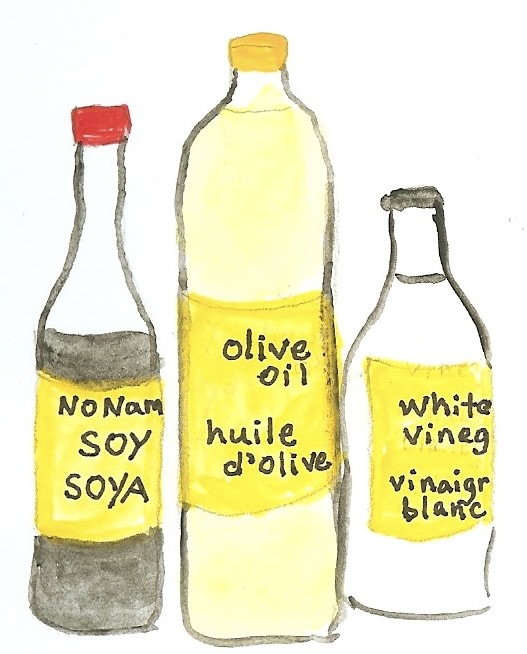
Home cooking comes with a pantry and a well-stocked spice rack. Away cooking is like camping: in a bare kitchen, I discovered the only staples I needed were olive oil, vinegar, and soy sauce. My salmon, broccoli, and spinach salads were easy and delicious, and dishwashing was a piece of cake, too.
Away eating is usually street food (roti, char siu bao, a baguette, a Greek salad, whatever I come across), so there’s less cooking (and I’m eight pounds less, too). Home eating means cooking, so it runs up against the do-over-and-over-again problem endemic to Chores.
 
Away comes with a landlord; Home comes with homeownership. Home ownership comes with Life Admin; it’s a love/hate relationship.
 
Away is escape
When I take my Months, Tim, Sophie, and my sister usually visit for a few days or less than a week. This time, Tim came for a month, and I found myself Preparing Speeches in anticipation: “I am not taking care of you.” Wow, I hadn’t expected that, but I realized that Away meant I wasn’t a wife, a mother, a caregiver, a responsible party. I was just Barbara. Although I was first in the Airbnb, I didn’t want to be the household manager, the keeper of Life Admin.
 
It’s different when Tim and I vacation; then we’re both tourists and equals experiencing a place, and we have a great time. But in my Months, I’m what a friend calls a “resident visitor,” and I’m making a life. It’s an act of creation, and I want to be free to explore it without introducing Life Admin. I startled myself with my vehemence – my ferocity even – I’m still pondering that.
 
Home means a Car
Away is public transit; Home is driving a car. My car is often my friend and I look forward to road trips; but public transit is my love. My Presto card and the TTC (Toronto Transit Commission) open up a whole world for me while I get to look out windows, not worry about parking or gas, be part of society. Public transit is walking out to a bus or subway stop and knowing one will come within a few minutes. It is not having to check a schedule for the 45-minute chance a bus will come. I used to run Anchorage’s public transit system, but Anchorage will always require a car.

My last streetcar ride in Toronto was very complicated: almost every stop involved a person in a wheelchair, walker, or stroller; so the ramp was often deployed and the aisle got very crowded. I could have been annoyed, but instead I thought: this is a place to grow old! People can still get around in their Third Third, no matter their physical state.

Home is comfort
Robert Frost’s home may be “‘… the place where, when you have to go there,/ They have to take you in,’” but Home is also the place that, when you’re not at your best, sick or hurting, “comes with a husband, a couch, a heating pad, a big blanket, Netflix, many library books, a teakettle, and a medicine cabinet.”
 
Home holds memory
When my mother moved out of the family home, she lamented the wall where all our heights were marked as we grew up. Those marks were a symbol of all that had transpired there, all the life and memories. Home holds that past. Away holds re-creation. In our Third Third, those two battle a tug-of-war.


Monday, April 29, 2019

What Taxes Buy

Buying anything in Toronto comes with a moment of surprise. I think I’m paying $2 to scan my artwork, but the clerk turns to me and says, “$2.26.” I ready $3 to pay for my $2.99 beverage, and the clerk says, “$3.42,” and then I have to fuss around in my wallet again.

It’s called tax, something tax-less Alaskans are not used to.

Now I’m going to describe a sample day – yesterday – in Toronto. First, I walk out to catch the 506 streetcar on the corner. Within a minute, it shows up. There are seats available – red plush upholstered seats – and I can tell when my stop comes up because the recorded announcement is clear and the sign showing “next stop” works at the front.


[This was so shocking at first: in New York City, the public recorded announcements sound like this: “ssshhhhXXXchchchhsssdsttt.” Here they say, “The next stop is Yonge Street, College Station subway.”]

So I get out at College Station and switch to the 1 subway at no extra charge. It comes within a minute, too, but that’s because it runs every 2-3 minutes. Every 2-3 minutes! I am in transit heaven – with more plush seats!


I’m going to the Deer Park Branch of the public library. I’ve never been there before, but Joanna Goodman, author of The Home for Unwanted Girls is speaking. There are 100 branches of the public library, and I have three within blocks of my apartment. I am always stumbling over yet another branch library in my wanderings.

Every few feet, I pass a litter/recycling box. All the litter boxes include recycling. At first, I thought people were just throwing litter in the recycling hole, not separating their recyclables, and it annoyed the daylights out of me. But then I discovered that here they recycle EVERYthing: any rigid plastic like plates and cups and containers (as long as they’re not black), juice boxes, milk cartons, pizza boxes, foam coffee cups and takeout boxes. So it’s not messing up the recycling; it’s DOING the recycling.

The compost bin even takes my dirty, food-covered napkins!

After the author talk – where every seat is taken and we’re all impressed and enthralled – I dawdle around downtown. I pass a homeless person asleep on the sidewalk, and two community service women are talking with him, asking him to stand. Yes, I’ve seen homeless people in this city of three million, but not to the numbers I’ve seen in Anchorage (one-tenth the size). I have also passed many clinics, social service buildings, detox centers. One storefront had a sign that it was a Sewing Repair Hub offering classes in sewing repair and then helping the women set up mending businesses (while keeping textiles out of the waste stream). They are addressing their social ills.


I stop at Soufi’s restaurant because I see that it’s a Syrian restaurant and I can have manakeesh, which I’d loved in London. Then I head to the main Toronto Reference Library where about 500 of us have been lucky enough to reserve a space to hear Sally Rooney, author of Normal People. (Did I mention that all this is free?) I pass the Newcomer Services Desk, where a woman is helping a new immigrant. Many of the libraries have those desks.

I’m sitting next to Joan, who turns out to be a major theater-goer, seeing two plays every weekend! Two plays every weekend! She turns me on to a play I hadn’t heard about, and when I get home, I immediately buy a ticket for it.

I could have waited till Saturday morning, when I go to my branch library and get a free MAP, Museum + Arts Pass. That’s how I’ve been to the Art Gallery of Ontario, for example. I can get one pass a week, but I didn’t want to take a chance the performance would sell out.
Heading home is no problem because even at night, the buses and streetcars and subways still come frequently and there are nice shelters that say when the next one is due.

A friend of mine lives here and says the taxes are very high, but his husband is very sick, and they can receive many, many services and quality care.

That’s what taxes pay for. This is what a community looks like when its citizens and businesses contribute financially to its operation. This is what a government can provide when it has financial resources. Only Alaskans believe it has to come free.


Friday, March 16, 2018

Philosophy on the NY Subway

As I prepared for my month in Manhattan, I discovered that I could get a personalized MetroCard – with a photo! – that would get me half-price on the subways and buses.

You have to know the transit lover in me to know the ecstasy that overtook me. I phoned them up right away: yes, I could come in with two photo IDs even before my birthday and I could get it right then and there. Hooray for turning 65!

So, of course, I took my sleep-deprived, jet-lagged, excited self down to 3 Stone Street as soon as I arrived. First, I had to find Stone Street, then I had to find how to travel there. I’m renting in a less-than-familiar part of Manhattan so I’m in the midst of direction-confusion and am back to writing little cheat sheets to myself after I examine all the permutations and combinations of MTA Trip Planner and my maps. Plus, I still have to learn how to lock the doors to where I’m staying.

I waited for my number to be called and headed to Window #1, and I received a gorgeous, yellow, Reduced-Fare MetroCard with my photo on it!

I can’t paint an exact picture of it here because I no longer have it. (Sob!)

After getting my gorgeous, yellow, Reduced-Fare MetroCard with my photo on it, I calculated which was the best deal for purchase. I could pay for a trip costing $1.35/trip; I could get a 7-day Unlimited Ride Reduced-Fare MetroCard for $16 or 11.8 rides in a week, or $2.29/day; or I could get a 30-day Unlimited Ride Reduced-Fare MetroCard for $60.50 which was the best deal in the whole wide world!

So off I went to the nearest subway station, to the fare machine. Nothing about it was intuitively obvious, but I came to the big existential question of the day: Was I going to “Add Value” or “Add Time”?

What would you say?

What would you say if you’d saved the attached quote in your journal for many years?


I can’t add hours to the day. I can’t add more days to a week or a month, but value? I can add value to my card (by putting money on it), value to my ride (by going for the 30-day option), and value to my whole life and the planet!

So I added value. Something didn’t look right. I went back to 3 Stone Street, got a new number and window #5: “You weren’t supposed to Add Value. You were supposed to Add Time. Nothing we can do about that now. We’ll take back your gorgeous, yellow, Reduced-Fare MetroCard with your photo on it and get you a refund in six weeks. Here’s a temporary, boring, plain old card you can go put another $60.50 on.”

Which I did.

Back to the station, I swiped my card in the swiper. It said "expired." I tried again. It said, “Just Used.” I tried another gate: “Just Used.” I’ll spare you all the back and forth trips for remedies. Eventually, a station agent let me in, and I boarded a train, slightly dreading that I wouldn’t be able to get back because my brand-new boring and untested MetroCard wouldn’t work.

But as I swiped it for the return, I saw that the message said, “Pass Expires 4/12/18.” Oh, it wasn’t expired! It was giving me handy consumer information! Bless those tiny little LED-ish messages that can’t be read in dimly lit stations! I just pressed the turnstile and was through.

This was a Big Day in my Third Third:
  • Turning 65 comes with unanticipated thrills! I have unlimited reduced fares on subways, buses, even the Long Island Rail Road. If I’m never heard from again, check with the MTA.
  • I still think I was adding value, not time. In the universe, I’m right. In the MTA, they’re right, and I’m finished arguing even though I did tell them they should have the capability to over-ride the magnetic strip.
  • They say we have to do really difficult things to keep our brains active, and plunging myself into a new environment, negotiating bureaucracies, figuring out how they could have done it better if I were in charge – all while panicking that I’d never get home – are just exercises to avoid cognitive decline. I’m not getting older, I’m getting IQ points.
  • It’s always about the adventure. I took four train trips today. I saw a parking lot with cars on elevators, I went to the Museum of Math on Pi Day, heard the author of Caesar’s Last Breath talk about air, had a 99¢ slice of New York pizza, got a New York Public Library card, and walked more than 70 New York blocks. All possible because I had a temporary, boring, plain old Reduced-Fare MetroCard.

Monday, May 15, 2017

Reflections on Return #2: Things I Loved about London

Parks!
    47% of London is green space. London’s parks are flat, wide, open expanses of lawn … except when they’re little, quiet spaces tucked into corners here and there. In the middle of a busy intersection, there’d be a square with lawn, flowers, benches, and always at least one statue. Everything clean and beautifully maintained. Something in me loved the openness, the flatness, the far-as-the-eye-can-see illusion. As an antidote to the big city, it worked.

Little nooks and crannies
    Gene taught me the word flâneurie, the act of wandering into secret courtyards and tucked-away corners as you explore a city on foot. In my own neighborhood, I walked behind the church and discovered Kensington Church Walk, a little alley with shops, a school, a little garden oasis. It was like entering a storybook. I couldn’t resist an alleyway in London.

British “Schemes”
    Unlike in American English, British schemes are not just secret or dishonest ones, they’re “a plan for doing or organizing something.” My favorites:
  • the Considerate Constructors Scheme: construction sites follow the Code of Considerate Practice which governs the appearance of the site and the construction workers, respecting the community, protecting the environment, etc. Construction workers dress in full neon jumpsuits – yellows, oranges, greens.
  • the Community Toilet Scheme: Local businesses make their clean, safe, and accessible toilets available to the public. There’s a pocket map, window signs, and an interactive map online. I only discovered this after carefully creating my own restroom directory, but what a great idea.
The buses! (of course)
  • The main entrance to the bus is on a level with the street so strollers, walkers, wheelchairs board easily. Then the able-bodied walk up the stairs to the upper deck. In the U.S., why does the main entrance require going up stairs, which then requires lifts and kneeling and all sorts of workarounds?

  • The upholstery on the buses is beautiful and pristine! In the U.S., we had to give up on that because they were carved up with knives. America is reduced to hard plastic.
  • Every Tube car has a readable map and an understandable voice announcing the stops. Every bus has a digital sign and voice announcing the stops. They’re not broken, out-of-order, or garbled.
The signage
    You figure this one out:
I loved that street signs are giant-size and way up on the sides of buildings so you can see them easily. No signs on poles blocked by trees or people or missing.

  • Their signs say “Way Out” instead of “Exit.”
  • All those life-saving, easy-to-understand, ever-available “You Are Here” signs!
No goose or duck poop at the ponds!
    I don’t know how they do this, and I’ve asked everyone I can. There are swans and geese and ducks and even a heron. The ponds are encircled by paved areas, but right next to those are the wide, grassy lawns. People lie on the lawns! They have picnics and play games! I don’t see them shrieking over landing on goose poop. In all my time in the parks, I only saw maybe two goose poops. Do they wash off the pavements? Vacuum the lawns? How do they do it?!?

Museum engagement programs and tours
    Every hour, the Tate Modern holds a different tour. Every day at 4 pm, the National Gallery has a 10-minute tour of a single painting; twice a day is the regular tour of five paintings. In between is “Listen and Look,” “Talks for All,” “Talk and Draw.” While everyone is just cruising through the museums, you have the option for greater engagement and immersion.

North End Road Market, Jaffa Bake House, Aly Mir’s tours, Time Out weekly magazine
    I took three of Aly’s free tours, ones he privately researches and orchestrates. His devotees are locals who come back for the new ones he adds to the repertoire. Not only did Aly remember me from tour to tour, but this was always the place people talked with me and reached out.

My friend Lynel just told me that on her recent visit to the Jaffa Bake House, they asked if I’d gotten back to Alaska all right and when was I returning! This is the happiest news of all, casting a warm glow over my whole time there.

Tuesday, April 18, 2017

I got this!

A few days ago, I relaxed. Not relaxed as in spending a day reading or lounging, but relaxing as in “I got this.” My whole psyche relaxed. The you-are-in-a-strange-city feeling that never went away … went away.

I had run through Kensington Gardens and Hyde Park, getting lost a little, but never feeling like I couldn’t find myself. Afterwards, I’d walked to Harrod’s (more an event than a shopping trip; I cannot imagine anyone finding anything they would actually buy in Harrod’s) and when I got outside, I noticed a #414 bus sign that said it was going to Putney Bridge, and I got on. I was going to visit my friend Lynel in Putney Common, and my little paper with Journey Planner notes didn’t have me going that way, but I still got on this new bus. And it worked.
Lynel mentioned a wonderful market, the North End Road Market, with very cheap grapes, and I discovered on Journey Planner that it’s a short #28 bus ride from my apartment. I’d never been on the #28 before. When I set out, I realized I’d left my Journey Planner cheat sheet at home, and I didn’t go back to get it. Not only that, I found “my” market for the rest of my stay.

I don’t need cheat sheets anymore. I know to look for the bus stop on the left side of the street, not the right. I know that if the ATM can’t dispense cash, it doesn’t mean I’ll be left destitute; it just means I have to try the machine next to it. I know good rest rooms in several corners of the city so I’m never desperate. They reopened the footpath that takes me right into Kensington Gardens so I don’t have to walk the long way around. I know how to send and receive texts on the iPhone.


Now I’m really enjoying myself!

After my fabulous month in New York City, I expected that I’d arrive in London and revel in excitement and pleasure right off the bat. But it wasn’t that easy here. In New York City, I felt like I’d entered my DNA environment, that I was surrounded by “my people.” I felt at home, a part of the culture and the way of being. I fit in right off the bat.

Before spending a summer in Costa Rica, I knew I’d be speaking Spanish, using a different currency, entering a different culture. I was prepared and ready to give it the time to become comfortable. I wasn’t prepared that way for London.

They may speak English here, but they’re British and I’m not. I haven’t figured out all the manifestations of that – and it’s interesting to reflect on – but I know it’s true. I’m a fish from a different ocean. I understand that, and it’s okay.


Important thing I’ve re-learned about myself in my Third Third:
       I need a certain baseline comfort level before I can appreciate my own adventurousness. Before I could feel relaxed in the apartment, for instance, I had to know where the light switches were, that this window opens more easily than that one, that the converter is more convenient in this outlet than that one. I needed to know that I kept underwear on this shelf, paints on that one. And knowing it automatically without having to re-think it each time. Once I could put 10% of my day into the routine column, I could handle the 90% of newness the rest of the day threw at me.

When I worked at the Anchorage Museum, I remember reading research on the best preparation for school field trips. Kids learned more on field trips when they were given instruction ahead of time not in content, but in where their coats will go, where the restrooms are, etc. It reduced their anxiety.

Now I know that every adventure either begins walking down Kensington Church Street to the High Street or up for Notting Hill Gate; turning left for the bus, right for the Tube. I don’t have to look at a map or plan my route. I just have to walk out the door.

So I do!


Friday, April 14, 2017

London with Someone Who Has Absolutely No Idea Where She's Going

Every day begins with Journey Planner, the London Transport online feature where you enter your “from,” your “to,” and whether you want to do it by bus or Tube or whatever. It even tells you which stop to stand at. Handy dandy, right?

The Journey Planner and I are having relationship difficulties. Journey Planner is fallible. Nevertheless, before I walk out the door each morning, I clutch a little piece of paper with my Journey Planner instructions. Here’s what a sample day’s might look like.
This is not even the most stressful thing about walking out the door. The MOST stressful thing is establishing – and reestablishing – that I have the key to the apartment. I think I’m developing a nervous tic of pocket checking. Here on my own, there are a few “no Plan B” potential predicaments, and getting locked out is one of them.

Now I’m out the door, but not to my usual #9-line bus, stop M. Today I’m taking the Tube from Notting Hill Gate. I reach the street and can’t remember whether it was left or right. I guess wrong. You can never get lost on the Tube. Never. It’s impossible. But you can get lost getting to the Tube.

I am waiting for the Circle line to Monument. The station always announces, “It might be faster to change at Earl’s Court for the District line.” So I courageously opt to change, this time to take the District line to Upminster (the last stop so it shows you’re headed in the right direction). But when the train shows up, it says it’s only going as far as Barking. Where is Barking?!? Is it before or after the stop I need?

This is like my third challenge of the day, and it’s still morning.

On the day I decide to visit the Columbia Road Flower Market, I have written out all my instructions … which correspond to nothing on the ground. Fortunately, there are wonderful “you are here” maps all over London.

I aim myself. I smell the flowers blocks away. The flower market is interesting and pretty and PACKED with humans on a 77-degree day. Too packed! All of London is on this street. I decide to take a different route back to the Tube station, seeing more of the Bethnal Green area.

Except I’m not. I’ve ended up somewhere else.

Soon I am on a street with graffiti and no handy “you are here” maps. The good thing about being in a neighborhood like this is that when I find a mom & pop store, I might be able to find cheaper grapes. Grape prices are my bellwether for judging cost. So far, grocery stores are running £4 a kilo, so I have to mentally convert both kilos and pounds. It comes to $4.98 for 2.2 pounds or $2.49 a pound. So that’s my benchmark. (Harrod’s grapes are £30 a kilo!) This mom & pop has 500 grams for £1, or half-price! I buy grapes. But I still don’t know where I am.
Finally, I see a nice, cool area to sit in. It turns out to be the front of the Victoria & Albert Museum of Childhood where I’d wanted to see the Board Game exhibit! This is the story of getting lost and getting found, and I go through it many times a day. Mild panic, great elation!

The exhibit is terrific. Not only do I learn that board game design followed the prevailing theories of childhood (play is good vs teaching is better); but I am lost in a nostalgia trip of games my siblings and I played. Mousetrap! Risk!

But now I have to figure out where I am again. The “here you are” map outside shows Brick Lane. I’ve already been to Brick Lane; I know Brick Lane! Brick Lane has the bagel (“beigel”) store! I’m found!

I arrive at a seemingly different Brick Lane: it’s market day and there are stalls in the middle of the street. Not packed, just fun and interesting. So as I’m pleasantly meandering down Brick Lane, I notice people walking into a doorway. I follow. Wow! It’s a take-away food extravaganza! There are stalls of people with electric woks from every country in the world: Singaporean food, Greek food, Burmese cuisine, Moroccan, Venezuelan! And on the outside of the building, a man is on a ladder painting a mural.

After walking down Brick Lane, I know where my trusty #15 bus stops, which will take me to my trusty #9. I spy a Tesco store, and now that I’m on my way home, I can get milk and won’t have to carry it too far. I go to the self-service cash register (“till”), and scan my milk.

“Place item in the bag loading area.” The voice booms out. I move the milk to the shelf.

“Place item in the bag loading area.” I move it to a different shelf.

 “PLACE ITEM IN THE BAG LOADING AREA!” I look around for a helpful attendant.

PLACE ITEM IN THE BAG LOADING AREA! I move the milk every which way. People stare. Finally, an attendant comes over and places my milk in the least obvious shelf of all.

I get so rattled by all this, I begin to leave … and spot my credit card still sitting in the machine. Yikes!!!! I could have walked out without it. Another “no Plan B” catastrophe averted.

My trusty #15 bus reliably moves along, with the reliably helpful voice announcing each stop and reliably showing it on the screen … until she announces we’re “on diversion” and we turn onto unfamiliar streets. Uh, oh! Uh, oh! Fortunately, I am going to the end of the line at Trafalgar Square so I don’t mind how divertingly I get there. And there’s bus stop S, right where it always is, right in front of the oh-so-familiar Canadian consulate on Cockspur Street!

I am happily practically home again, with my keys in my pocket. (I checked.) Another glorious, adventurous day. I’ll recover by morning.


Sunday, March 27, 2016

I don't get it.

Every now and then, I encounter a New Yorker thing that I just don’t get. Sometimes it just seems odd; other times, it’s a way of living that I don’t (wouldn’t?) participate in. Take, for example, the concept of “books by the foot.”

At the Strand Bookstore:
We can assemble a great book by the foot collection for you that will satisfy the mind and please the eye. Book by the foot collections can be made to order based on color, binding, material, size, and height to match your specific style and home decor.
Who picks their reading lists by color, size, and height? Oh, I see, they’re not to be read. And Steven Spielberg is one of their clients? Oh, I see, maybe he’s doing it for movie sets. I hope so.

I also don’t think New Yorkers cook meals, but that just may be New Yorkers who live in apartments. Or maybe that’s just New Yorkers who live in Manhattan in studio apartments. I’m still trying to get to the bottom of this one.

My apartment has a dishwasher. As my cousin pointed out, there’s not enough room in the cabinets to have enough dishes to even make a load. There’s not enough room in the cabinets to stock any staples. A friend of mine’s fully-equipped, high-end kitchen still has only two burners. I was in a delicatessen one evening around 5:30. Suddenly, I was swamped by people ordering a half-pound of this, a pound of that. They don’t cook, they “heat up.”
New Yorkers and their kids ride scooters, not skateboards. Kick scooters, like Razors, the ones Sophie and the Alaska kids had when they were little and which are now clearly an old, dead fad. Not in New York. That’s what they ride here. My guess: in a crowd, it’s easier to pick it up and over a curb than bending down to retrieve your skateboard with your head in everyone’s butt. But that’s only a guess.
Runners. Runners here run in thick crowds, on concrete, around obstacles, on horrible paver stones. I am a spoiled runner. The idea of running in and around LOTS of people who are not running, who are strolling or just waiting for a bus – who are wearing suits! – is beyond unappealing. I can’t even believe these runners attempt what they do – why? They’ll ruin their feet on the concrete, and what kind of meditative experience is it? But that gets to Nature and wilderness and Alaska and me, and that’s a subject for another day.

I don’t get what the trucks are doing between 2 and 5 a.m. that can possibly make THAT MUCH NOISE right in front of the apartment building. The doorman thinks they’re unloading and reloading office furniture … every night of the week. I checked … and that’s what they’re doing!

Sometimes, the thing I don’t “get” is more profound. I spent one afternoon at the Transit Museum in Brooklyn. They had an exhibition on operating in crises: 9/11, the power blackout of 2003, Superstorm Sandy, etc. Going through the 9/11 photos and video testimonials was powerful. Regular subway operators described how they encountered terrified people in the Cortlandt Street Station and stopped to jam them on the train because they were so frightened. Bus drivers ferried as many people as they could out and home. Photos of New Yorkers – more than you could ever imagine – walking across the bridges trying to get home.
I was in San Francisco on 9/11 for a week’s run of my one-woman show. Flight 93 was headed to San Francisco; it was full of locals. The City was put on lockdown, the Golden Gate Bridge was closed. 9/11 felt very immediate. We all know where we were when it happened.

But I wasn’t in New York City. Ground Zero was GROUND ZERO here. Regular old people in their regular old jobs had to take on emergency duties, had to take on life-saving duties, had to conquer their own fears and step up. Had to live with what happened that day.

9/11 wasn’t TV coverage for New Yorkers. It was right here, and they had to deal with it, go to sleep to it, wake up to it, live with it. We all know the “you had to be there” feeling, the way you just can’t describe something to someone who hasn’t experienced it. The New Yorkers who lived through 9/11 were touched in a way that I was not. I have a new and profound respect for their ability to get up, get moving, help out, face grief. I imagine they look at each other and know, in their souls, “We were here.”

I wasn’t.

Saturday, March 12, 2016

Living Vertically

There are lots of things that thrill me about cities, but the one that never fails to amaze me is what I call “people living on top of each other.” Not in the figurative sense of crowds, but in the literal sense of people living in an apartment on top of someone else’s apartment on the floor below. I stand at ground level and look up at what’s going on in lighted windows: someone eating is completely unaware that someone just below him is watching TV. It just amazes me.
In New York City, I can look up at an apartment building and see SIXTY people living on top of SIXTY people who are living next door to another SIXTY people living on top of their SIXTY. It boggles the mind. Which leads to the other thing that awes me: at 8 a.m., all those people are usually changing places. They’re leaving homes for work or school or whatever, and they’re often doing it via public transit. It’s why I got into transit in the first place. Just think about it: all the people living on top of each other changing places in about a two-hour period.

Gasp.

So when I heard that the curator of the Skyscraper Museum exhibit, Ten Tops, was doing a curator’s walk-through, I went. (There are so many exciting things implied in that sentence: that a Skyscraper Museum even exists, that it’s a dynamic museum with changing exhibits, and that they offer a curator’s walk-through and expect people will come! This is New York!)

The exhibit focuses on the two dozen or so buildings that are 100 stories or higher. The Burj Khalifa building in Dubai has the highest occupied floor in the world. More than 900 households live there with the possibility of living on top of 87 floors of other people.

But the big thing I learned from the curator was about wind. The museum is filled with the models used in wind tunnel tests. I learned wind is why these buildings are all pointy or oddly shaped. Wind is a killer on a regular old rectangular building; you need angles to confuse and disrupt the wind.


One of the more inspiring buildings, the Shanghai World Financial Center starts out at the bottom as a square, but the architect used angles and arcs drawn off a circle to slowly transform it as it rose so that at the top, it’s six-sided. The very, very top was designed to have a circular hole (and they’d install a ferris wheel), but when the owners saw it, it looked like the rising sun of the Japanese flag so it was nixed. Now it’s a rectangular hole.


To understand how scary the wind is, the curator showed us photos of the “tuned mass damper” (TMD) in Taipei 101, which was the tallest building till Burj Khalifa. It has to withstand not only typhoons – up to 130 miles per hour – but also earthquakes. The structure likes to be flexible, but the people inside like it not to be so flexible. (I can see why.) So inside, there’s a giant 660-ton sphere, 18 feet in diameter – that’s the TMD – that hangs like a pendulum around the 90th floor. When the wind blows, it swings the opposite way and stabilizes the building. It can swing up to 59 inches!

[Pause while woman from Alaska-via-San-Francisco has small, sympathetic freak-out over this: swaying from wind and earthquakes is the worst thing I can imagine in the place where anyone would live. 59 inches – that’s almost five feet of sway! And that’s the stabilizer!]

I am staying in an apartment on the 8th floor. It is not so bad because the people on the ground still look like people, not ants. I can look out in the morning to see whether they’re wearing coats or not (although New Yorkers seem to wear parkas and scarves that would leave any Alaskan with heat stroke). I am not anticipating any earthquakes.

So while I’ve always marveled at looking at all the people living on top of each other, this is the first time I’ve actually been one of those people. Sitting here at my table, I’m not even aware of the seven households under me. I only see them from outside. I haven’t even checked how many might be living above me; I’ll have to look at the elevator buttons.
It’s a new perspective: to be what you’ve always just looked at. But that’s what this whole trip was meant to be about.


Tuesday, March 8, 2016

The grapes of ... New York

My first order of business was getting a New York Public Library card. Now, after two days, I realize I’d better leave some time for reading or else my feet are going to break. I have covered ground! One block of interesting things leads to another block of interesting things. By the end of the day, my feet are screaming.

So my second order of business was getting my Metro Card. But that was also because of the grapes.

I love my grapes. I can go through a Costco 4-pounder in two days. So here I am in Midtown Manhattan. I stopped a man with a dog and asked where a grocery store was: “Right on the corner.” It was a little fancy, but it wasn’t till the checkout line that I realized how fancy: $11.62 for two pounds of grapes!

So the next day, I Googled “Costco.” There was one in Manhattan, in East Harlem. I could take the #6 subway to 116th Street (where I could also visit the Hot Bread Kitchen, one of the sites for New York’s best challah and a women’s employment bakery to boot). I’d load up at Costco with my daypack and big cloth bag and take the M-15 bus back. Too exciting for words!

I got off in East Harlem and realized this is the New York I love: ethnic, “un-sanitized,” full of nooks and crannies that aren’t designer clothing shops. There are real things, like real grocery stores. And even the Costco was a little different: it has Jewish food. I stocked up on Gabila’s potato knishes. The food ladies had samples of … Marinated Wild Alaskan Salmon, 6 pouches! I realize that I’m going to be cooking in servings rather than meals; I think that’s how New Yorkers eat, or at least how they shop. I don’t have all my ingredients, and though the kitchen is well-equipped, it wouldn’t even be able to hold my spice rack from home.

Four pounds of grapes = $9.99

Back at the apartment, I decided I’d look for the East River for a running route. So instead of turning left out the front door, I turned right. I was in Dag Hammarskjöld Plaza, where on Wednesdays, there’s a Greenmarket … with the Hot Bread Kitchen! I looked around the corner, and it was the United Nations! I am right on the corner of the U.N.! No wonder it’s Dag Hammarskjöld Plaza! I looked back, and there was The Trump World Tower. And condos starting at $2.1 million. Oh, yikes.

Still in search of the river, I turned left and the street sign said “Beekman Place.” No, NOT Beekman Place! In The Way We Were (the only movie I have seen four times), glorious, brash, Jewish lefty Barbra Streisand discovers that husband Robert Redford has had an affair with a wealthy, WASPy woman whom she calls “Beekman Place.” I am living right off Beekman Place! Horrors! No wonder their grapes are so expensive.

So I have to neutralize my proximity and head downtown, towards the Lower East Side. I made it to Kalyustan’s acres and acres of spice store. I just needed oil and vinegar but that took hours of browsing hundreds of bottles, types, and ooh, that looks interesting over there. Then I had to hustle to the library for my first author program.

As I walked back to the apartment – feet just screaming yet again – I noticed a crowd on the sidewalk. A fruit vendor was doing a fiery business. Of course, he had grapes for $1 a pound ... and they looked just like my Costco grapes, in the same packaging.

I have a month to learn how New Yorkers do things.

Wednesday, December 30, 2015

To pee or not to pee

When I drink water, I pee a lot. I’ll drink several glasses of water during a meal, and then I have to make sure I’m somewhat near restrooms for a couple of hours afterwards. If I’m going to change locations, I always pee before I leave because you never know what the restroom situation is going to be like. You never know if you’re going to get stuck in a snow bank, have a flat tire, or get in an accident, either. Better to pee before you go.

That’s also advisable because you don’t want to race into a place careening for the restroom. To find out, for example, that there is no restroom near Banana Republic and you have to head all the way over to Nordstrom … and you might not make it. There is a reason why friends call accidents “Title Wave moments,” after the bookstore one of us just couldn’t quite make it to.

Mostly, no one would ever notice how much I pee. But in my Third Third, I have the time for long, really long, lunches. So I drink a lot of water (no iced tea, carbonation, or caffeine). And I visit the restroom three times minimum while my companions seem to have iron bladders. How do they do that?
On a road trip, my sister couldn’t get over how many times I had to use a restroom. She told me to see a doctor. My doctor said there’s nothing wrong with me, that she has to pee a lot, too. She says it helps to have protein when I’m drinking, but I don’t notice any improvement.

Mostly, this wouldn’t bother me. I know the good restrooms around town. I even spent some of my time as a columnist as the Toilet Police because back then I was concerned that all the stuff they were adding to toilet stalls – mainly gigantic toilet paper holders – was making it impossible to turn around. So I have a little restroom map in my head, and between bookstores, office buildings, and little shops, I distribute my water.
[Little aside: that isn’t my original thought. John Irving, in The Water-Method Man, conjectured that water invented people so it could relocate.]

This is also Alaska so a lot of peeing happens outside. That is so perfect: you don’t have to “find” a restroom. You just have to squat, carry supplies, and take them with you. Once you get used to this, you can pee anywhere. Even by the side of the road, you say, “I’ll never see those people again anyway.”

Which, however, was not the case when I was racing across town and the store restroom was closed and the Costco restroom was undergoing maintenance and the library restroom was occupied and so I looked at one of those green power boxes by the side of the road and ducked behind it. Only to have a bus come by. Me? I used to be the manager of People Mover. I know the bus drivers. So I waved.
But all this peeing has some awkward sides. Like bus tours. On our trip to Machu Picchu, our guide NEVER needed to use the restroom. Thank heavens for Carol; she and I shared “baño” hunt duties. Her husband, Art, pointed out an overhead sign with a stick figure. “No,” I said, “that’s the evacuation route sign. That man is running.” “Oh,” Art replied, “I thought he was running for the restroom.”
So right now, all this peeing is a source of merriment, a route to discoveries (found: new, clean, public restroom in Midtown!), even a bonding experience among women. At worst, it’s only awkward.

But eventually, it gets scary: my mother is 90. She’s so afraid of incontinence, she stopped drinking. Dehydration causes a host of other problems so her kids nag her about needing to drink more. She says she’d have to spend all her time in the bathroom, and it’s a little complicated because she also now wears pads. When I visit, she points out how many of the dining room seats all around have stains from resident accidents.

Is it any wonder I gave up iced tea?


Thursday, December 24, 2015

On my own December calendar

I just realized that when Christmas time comes around, I know I’m not part of a work place. This is how I know:

There isn’t an unreasonable amount of baked goods showing up at the common tables as people try to get it out of their house … and into their co-workers’ stomachs. (Same goes for post-Halloween) I don’t even let the stuff cross the threshold of my home.
Being Jewish in 24/7 operations like public transit, I usually took the Christmas Eve and Christmas Day shifts to free up others for their holiday. (A plus for a diverse work force!) It was actually easy duty: things just sort of tapered off. Office people started keeping irregular office hours, disappearing here and there. Phone calls and emails weren’t returned or got automatic replies: “Won’t be returning till January 4.” So unless there was some terrible snowstorm or traffic accident, things were pretty slow.

Even when I worked at FedEx, the flurry of the preceding days was finally over. We managers had hustled into uniforms and vans, picking up, delivering, and tracking packages upon packages. Everything was a hubbub … and then it stopped.
Everywhere else, the time before Christmas and between Christmas and New Year’s was slow motion time. I was in the office, but there were no meetings, no deadlines, no critical conferences. It was the time to pull out the stack of unfiled papers and file them, to create new file folders and labels, to clean off the desk. It was like readying myself for a crisp and clean New Year, like the spring cleaning of the winter.

All that changed during the Years of the Child. Then you had to have your plane reservations done a year in advance to make sure you got on school vacation flights. Every family in Alaska was aiming toward sun and warmth and we all wanted the same flights out and the same flights in. Finally, graduation came, and we were no longer constrained by the academic calendar. We could slide into January for vacations. Things got way cheaper and less hectic. I was back in the office, cleaning up files and providing office coverage during the holidays.

But it wasn’t till now, in my Third Third and not part of a consistent work place, that I realize the rhythm of my calendar has changed. I’m on my own calendar, not the work place holiday calendar, not the school vacation calendar, not the Christmas shopping calendar. Yes, there are a lot more parties and receptions – and there were all those pre-holiday crafts fairs – but that only changes my entertainment, not the schedule of my days.
Well, actually, I realize that’s not true: my volunteer teaching gigs are taking school breaks. I actually have a couple weeks without any class times scheduled. I do feel slower, more flexible, readier to say “sure, I can meet you for lunch.” I visit friends in their slowed-down work places.

So what’s different? In some ways, it’s like September. For a large part of my life, September meant school was starting. It’s when we bought new fall clothes and new school supplies. It’s when we were starting fresh, launching into something new, entering new doorways – or shepherding our kid through them. This feeling of big beginnings was way more than an arbitrary, middle-of-the-school-year New Year’s Day could arouse. It took years – years! – after the school calendar ended for me not to think of September as the new beginning. And then one day, September just became September.

And now, December 24 through January 1 is just … December 24 through January 1. What a relief.


Thursday, September 10, 2015

A Love Affair Reawakened

I’m back! Tim and I took a rescheduled trip to Portland, highest on the potential-relocation-over-the-next-years-if-we-relocate locations. It’s high up there for a number of reasons, but this trip was a recon mission to see if it would survive inspection. With Mimi’s generous offer of a place to stay, we got to see it close-up.

Not a fair test: It only rained once when we were there and never soared above 80°. I’ve been really worried about this summer’s 90-100° days. They’ll have to refrigerate me. And I’m not too comfortable with grayness absent the bright reflection from snow.

I will have a lot more to say about Portland in the next few days, but

What I liked a lot:

  • all the almost-self-contained little neighborhoods with their own distinct characters

  • Art in the Pearl – an outdoor festival (crowded, too!) and the programs and speakers and interesting things I kept finding on a daily basis – New Things!

  • the front porches on most of the houses – I could imagine sitting on one and saying hello to my neighbors or just reading.
But on all those porches, we only saw two people actually occupying them. It reminded me of a Bay Area essay I read once: a woman bought Adirondack chairs because she had visions of having lemonade, sitting the glass on the wide arms, relaxing and enjoying life. She got rid of them years later, having never sat in them. A story that just stuck in my brain.
Now, what I loved about Portland: the MAX and buses and streetcars and 1-day Passes and Red Lines and Blue Lines and the #19 bus and the #12 and the #83 and the Washington Park Shuttle.

As we got in at 1:30 a.m., I said to Tim, “Thank you for a terrific time,” and he said, “You’re just happy because you got to ride buses.” Yes, yes, yes! Lots and lots of buses and MAXes.

I’ve liked soccer in my time, but it faded. I’ve liked gardening, but that faded. I even liked cheesecake, but that faded, too. But it is so thrilling, so affirming to see that my love affair with public transit is still thriving, that it still brings me tremendous joy. Here I am, in my Third Third, and a great love endures.

When I first moved to San Francisco and got my first monthly Fast Pass (unlimited rides!), I felt like I was given the key to the city. I would ride buses from one end to the other on a Saturday just to see where they went. I marveled how at 7:30 a.m. all the people were Here and then, by 8:30 a.m., they were There. Ultimately, I was a founding member of a citizens’ group to support public transit and then eventually, I went to work in the transit field. That’s what brought me to Anchorage, too.

Since then, I’ve done a bunch of things, but whenever I travel, I ride transit. When I realized Portland had a 1-day Pass, I was delirious: the key to the city again! I don’t think Transit Joy is explicable: is it the view from the window, the figuring out the schedule and the map, the order in the universe that’s affirmed when my transfer is right there when I get off my first bus? I try to figure out the logic of why a bus is routed here and not there: what’s it connecting? what’s it missing? I watch the bicycles being loaded on and off and wonder what happens when a third bicyclist wants on and there’s no room?
In San Francisco, people used to try and schedule meetings on top of meetings, and I would say, “No, I can’t get there at 5:30 if I’m not finished till 5:15 here.” And people would say, “It’s only 10 minutes away,” but they’re traveling by car and they’re forgetting the time it takes to get in the car, park the car, walk from the car. So the bus schedule reinforced the pace of life I wanted to live. (And yes, I know all the things buses can’t do well: taking kids to child care and school, schlepping stuff, doing ten errands in one afternoon.)

But bus love – it’s not really a thing with reasons.

Sharing Button