Pages

Showing posts with label cooking. Show all posts

Thursday, May 21, 2020

Beware: Exciting Project Ahead

You may be wondering where I’ve been. Well, of course I’m still hunkered down at home, but that’s where I fell down the rabbit hole.

I promised myself – as I heard tales of people learning Italian or finishing novels or writing sonatas during Covid-19 – that I was not going to be one of those people.

I most certainly was NOT going to organize my unsorted photos. I’d flunked that before.

This all started with the daughter – who used to have a chef at work preparing her meals – phoning to ask for some recipe favorites from home. I felt so … flattered. I eagerly pulled recipes from my cookbooks, magazines, index cards, folders, and scraps of paper and sent them on.

But as I scanned a few cookbook pages, I discovered other recipes – long forgotten ones – that had “delicious” marked on them. In my ratings hierarchy, “delicious” is the top. Those recipes get added to what I call The Repertoire. Yet these had been forgotten, buried in the pages of the cookbooks, lost in recipe clutter.

In this Covid Spring, I’m ordering grocery pickup like a military logistics person: how can I use every bit of produce so it doesn’t go to waste? I go through my cookbooks, maximize my ingredients. When I see an unknown, unremembered “delicious” – marked in my own handwriting so that other Barbara must have really made it – I try it again. It’s still delicious!

I am not and have never been a foodie. When I take my urban infusion months, I don’t visit fancy restaurants; I eat street food. I don’t know the names of famous chefs or 5-star restaurants. My fascination with food starts and stops with The Great British Baking Show.

But it’s Covid Spring and I’m reading cookbooks page by page.


I’m also getting my daily email from Shutterfly to make a photo book with big discounts and free shipping if you order by Tuesday. That’s not going to happen, but maybe I could eventually make a photo book of our favorite recipes. Maybe I could scan in those original, oil-stained pages – unbury them. Maybe I could do this over a year or so and catch whatever discount was in play.

So I start.

Soon I’m immersed in recipes. I’ve broken the bindings of two cookbooks from scanning. I have little slips of paper with headings: Holidays, Soups, Salads, Appetizers and page numbers. Or magazine pages, torn out. Or more slips of paper.

I’m artfully arranging pages, designing headings and comments and stories. This is so creatively absorbing, I can’t blog. I can’t garden. I can’t watch Netflix. I am a recipe-aholic. It’s delightful.


Then I get an idea: add photos of our family eating some of the dishes.

That’s when I pull out the huge carton of unsorted photos. That’s the door to the abyss.

The floor of my office is covered in photo envelopes and little tags: 1999, 2000, 2001, etc. Instead of just looking for food photos – which I found – I became obsessed with … ORGANIZING.
Organizing is a curse. I emailed my siblings: what year did we go to Victoria? What year was the first Girl Scout Encampment? I’m not only dealing with photo clutter, now I’m dealing with the terrible confirmation of memory loss.

It gets worse. For the Salad section, I wanted the photo our family calls “Sophie Salad.” She is an infant, and we have put her in our giant wooden salad bowl. I go right to the album, and the spot where that photo has always been is BLANK! Yes, I remember I’d pulled it to make her yearbook collage in high school, but didn’t I put it back?!?

I tear the house apart. Ultimately, I go through every single photo envelope looking at negatives. Negatives! Hundreds and hundreds of negatives. This is not a rabbit hole; this is solitary confinement in the cuckoo’s nest.

But I found it!

This is a Pyrrhic victory. I have won the battle, but lost the war. My enthusiasm for the great recipe photo book has waned. I don’t even want to cook any more. I can’t face the piles of photos and tags strewn across the floor. I should just pack them up, clear them out, and de-clutter my brain.

So now I’m gardening.

Wednesday, April 15, 2020

More than a Vegetable Quest

Somebody on Facebook said he realized what he misses are non-essential businesses and touching his face. I miss browsing vegetables. I miss grocery shopping.

It’s hard enough saying goodbye to the farmers’ markets in the fall, those luscious, healthy, green and orange and red and gold vegetables in all their glory. But at least I could go to the grocery store and see my vegetables up close. I could observe them, evaluate them, choose them.

But now I’m supposed to use the free pickup service, to send in my list and have some stranger decide which bananas to give me. Would they be the just right greenish-about-to-ripen ones, neither too big nor too stubby? And what about asparagus – would they choose the young, skinny ones or the old, fat, stalky ones? If the eggplants were no good, how could they revise the menu I’d planned and skip the mozzarella if they didn’t know what meal the eggplants were for?


Obviously, this is a control issue. In our upside down world where we’re losing control over so much – seeing friends, teaching students in person, being able to travel – here I am, fretting over being able to pick my own vegetables.

My friends say, “Stay inside.” My friend Margie says, “Adapt.”

She’s right. This is just my own personal stumbling block. I have to get over it.

So I do. I go online to the Fred Meyer website and am pleasantly surprised by the range of selection: they have photos of everything, detailed descriptions of brands, and even a whole catalog of things I’ve purchased in the past. I’m so relieved, I don’t even freak out about how much Fred Meyer and Kroger know about me.

I place our order, but pickup is five days out. Although I’m still just cooking dinner – same as what I did Before – it’s now a much bigger process. I don’t cook meat, so I rely on vegetables. But now I have to plan meticulously, maximize my resources without any waste, get what I need because I can’t just dash out if I forget something, make sure I use all the spinach before it goes bad. It feels like a strategic operation, a battle plan. It takes way more time.

But all goes smoothly. A friendly young man delivers the groceries to our car. We get home, stage some things in the garage, wipe down the other things. The bananas are just right, so is the zucchini, the eggplant, the green pepper. But what’s this? Where I’d asked for about four stalks of celery, I now have four whole bunches of celery.

What can someone do with four bunches of celery?

At least it’s not what happened to my friend, Michele: she ordered four chicken thighs and got four PACKAGES of ten thighs each.

My friend Sharon of the 400+ cookbooks went on a research mission to find me celery recipes. I now have jars of pickled celery brewing, but the most promising recipe, the one that could make a real dent in four bunches, called for Half & Half. I didn’t have Half & Half.


So, for the first time since before quarantine, I donned my double-layer-batik-quilt-fabric mask and went into society. I went to Fred Meyer very early. The store was mostly empty. I passed by an enticing, colorful, delicious-looking produce section – oh the temptation! – but raced to the dairy cabinet and grabbed the Half & Half.
The cashier was behind Plexiglas, but afterwards, I felt compelled to thank her for being there, for coming to work, for being so essential to us all. She thanked me, told me to have a nice day. But when I got home, I realized that in thanking her, I was probably beyond the Plexiglas. I’d probably leaned closer, probably closer than 6 feet. I’d put us both in terrible danger!

I thought of the 1980s, when I lived in San Francisco and friends were dying of AIDS right and left. One night, a gay friend called me, totally distraught: he had just had unprotected sex – what had he done?!? How could he have been so reckless?!?

That’s how I felt for starting a conversation with a grocery store cashier.

Unprotected conversation. How could I have been so reckless?!?

Tuesday, November 12, 2019

Lefse Lessons: Trial and Error Error Error

A lot of my Quests for New-ness (my method for keeping life from getting stale) involve cooking. Cooking is so prone to staleness – dinner every night over and over and over again – that it needs dedicated intervention to liven it up make it bearable. So there was the Sauerkraut Saga and the Medieval Mustard Mission. Twice, I discovered parables for living with a brand new pressure cooker – once when I bought it and once when I wrecked it. But even if none of those had worked, there was always Barbara’s Ginger Beer Factory, raspberry liqueur, Bourbon Salmon, and further misadventures with alcohol.


Hmmm, cooking Quests for New-ness always seem to involve a certain amount of calamity. Well, New-ness doesn’t come without risk, but how else would I have learned how to whomp mustard?

So when the Sons of Norway put out a call for help making lefse, how could I resist? It was time to call Connie, and that was before I knew that we’d end up covered in flour. Connie and I are really good at getting dirty.

We entered Viking Hall and right off were greeted by Amanda. The same Amanda who’s taught me watercolors and pencil drawing! She teaches lefse rolling, too!

First we have to prepare round boards for rolling on. We cover them with round, pastry cloth covers and pull them snug. Then we have to sprinkle enough flour to cover up the printing on the cover. Lots of flour. We pull a little sock over the special ridgy rolling pins, too. More flour.


At one end of the kitchen, other volunteers are boiling potatoes, ricing them with flour, and making balls to put in the refrigerator. I take a ball from the plate of finished dough balls, put it on the rolling board, pat it, and push it a couple of rolls. Dough sticks to the rolling pin sock. Not enough flour. Get a new sock. More flour.

You have to roll in alternating directions to make sure your lefse maintains Round. My Round is Round-ish. My Round is basically just not square. Or it’s square with bulges here and there.


When your dough is a super-thin pancake, you stick the long, special turning stick under it. One side of the stick is rounded and one is flat. Flat-side down, you scrape under the dough to release it from the board. Then you lift up the pancake.

Then you pick up the pieces that have broken and fallen. Reject!

You roll out another, super-thin. So thin, there are holes in it. Reject!

You roll out another, but it seems most of your flour has been absorbed. You can’t get the stick underneath. Reject!

When you finally get a pancake to stay on the stick, you walk over to the griddle to lay it down and cook. Not so easy! It’s big and floppy and thin, so it falls on the floor before you can make it to the griddle. Reject!
You try to make one a little sturdier, but it’s too thick. Reject!

You roll out another, but it sticks to the pastry cloth. Reject! More flour. One woman volunteer talks to herself, “Flour is our friend. Flour is our friend.” She’s right! I am now covered in flour, but I’m making round-ish pancakes! I turn to the griddle … and my lefse lands with all its sticky sides sticking to each other. Reject!


Connie decides that productivity demands she give up trying to deal with the griddle. She’ll just roll. But Amanda doesn’t give up on us: we have to hold the long stick very low to the griddle and twist it so that the pancake slowly unwinds itself. It’s a balancing act of original placement on the griddle and unwinding over it. Some make it, some don’t.

Once on the griddle, you use the brush to brush off the excess flour. And because flour is now our friend, there’s a lot. Grill the other side and add your lefse to the mountain of lefses on the counter under the sheet. Other volunteers are brushing off excess flour (Flour is no longer our friend.) and packaging the cooled ones.

So much to learn! I am trying to decide if a valuable learning experience for me is a net-productivity-loss for the Sons of Norway, but by now, I’m churning out lefse. Well, I’m producing lefse. I’m not exactly a lefse factory. They can package my round-ish lefse mixed in with properly-round lefse, so maybe no one will notice.

I am exhausted. I whisper to Connie, “Two hours.” She looks at me in shock, “Two hours MORE?” “No, no!” I say. “We’ve been here two hours. I think we can leave.” Everyone else in the room is still toiling away. They were there yesterday and they’ll come back tomorrow. They tell us to taste one
before we leave. (We kindly pick from the pile of rejects.)

We butter it, sprinkle it with cinnamon sugar, and roll it up. It’s delicious!


And now I know how to make it! But first I need a nap. 

Wednesday, June 6, 2018

A Ginger Beer Factory

I don’t like beer, and I don’t do alcohol, but I do like ginger beer. If I close my eyes, I can conjure an image of happily sipping ginger beer in the sun. Sort of like my images of restfully, calmly drinking tea. It’s a symbol.
So when Anchorage Community House offered a class on Natural Sodas – to include “probiotic honey lemonade and ginger beer” – I was hooked at ginger beer. Not to mention “walk away with final instructions and full bottles.”

I re-discovered my friend Laura as the teacher of the class, too. She assigned us to stations to mix up our varieties. I grabbed the ginger beer station, and my job was to boil sliced up ginger for 15 minutes. Someone else was squeezing lemons, and all of us were sterilizing old kombucha bottles.

After I added sugar, cool water, and lemon juice, Laura poured in her Ginger Bug. Ginger Bug is like sourdough starter; it has to sit and ferment. Since we were doing the make-it-in-2-hours version, we relied on Laura’s homegrown Bug to kick off our natural fermentation.

Then, proudly carrying our bottles of sodas, we went home with instructions to place them in a warm spot and keep a good eye on the pressure. Laura had several stories of bottle explosions in her garage or in someone’s backpack. As long as the soda remains warm, it will keep bubbling and bubbling. You have to get it cold to slow down the process.

This was a Sunday. We were told to check on our bottles on Tuesday, that the plastic lids might bulge a little so we’d know they were building pressure. I stuck my bottles in the laundry room, on top of the boiler.
And forgot about them on Tuesday.

Wednesday morning, the plastic lids were pretty bulgy. Wow, I had made them on Sunday and now, easy as pie, I had soda in three days! This was a miracle! This was even better than the Grand Sauerkraut Experiment. My friend Jinnie says it was the elation of feeling “I can sustain myself” when she grew her first lettuce. I had made soda!

I opened the Honey Lemonade Soda and WHOA! I had a spouting champagne bottle of Honey Lemonade! Foaming bubbles all down my elbow. I raced for the kitchen sink.
Where I tasted some pretty terrific Honey Lemonade Soda.

Fortunately, Ginger Beer wasn’t as out of control. Ginger Beer was perfect. Ginger Beer was terrific! Ginger Beer was a total and complete success!

I have to become a ginger beer factory. Visions of bottles and bottles and bottles happily – yes, happily – dance in my head.

But first, I need to make my own Ginger Bug. I need organic ginger root. I am not sure where to find it, but my friend Judith phones, “I found it at Carrs. It’s right here: organic garlic.” We both think this solves the problem. It takes us a while to realize that, even though they both begin with G, garlic is not ginger. Never mind: Costco has a big tub of organic ginger.

I grate my two tablespoons. I add my tablespoon sugar and two tablespoons water. I make two jars of this because I am an aspiring ginger beer factory. I put it on top of the boiler.

My factory will need bottles. I need lots of empty kombucha bottles with plastic lids. Note to readers: I will take your old kombucha bottles.
The next day, I add more ginger-sugar-water to my Bug. It’s called feeding, but my Bug is listless, decidedly unbubbly. I examine it. I move a chair into the laundry room so I can reach the top of the boiler and watch the pot not boil. The next day, I feed the Bug. I pepper Laura with questions.

I watch my Bug.

I go to Costco, where I notice they have cases of the right kind of kombucha-in-bottles for sale. I notice that the food ladies throw out the jars of whatever they’re offering, so now I have to figure out how to get Costco to offer samples of kombucha so I can get all the throwaway jars. I spy a woman with a case in her shopping cart. It takes all my strength to muster the correct social prohibitions so I don’t give her my phone number and ask for her used bottles.

Laura suggests I dump the Bug and start over again with organic sugar and stale water left out to de-chlorinate. Maybe that will help. Even Laura has occasional Bug flops.

It will take me a while to get the Bug going, but it will also take a while to get all the kombucha bottles I need. After that, I’ll worry about the refrigerator space. Because I am going to sip ginger beer in the sun.

Tuesday, December 12, 2017

A Food Love Story

Our kitchens are filled with stories, but some stories lurk in one special dish. It’s the dish with a whole history behind it, a history you can’t separate from preparing, tasting, eating that dish. So let me tell you about noodle kugel.

Noodle kugel is a traditional Jewish side dish. When my mother first made it, Mott’s had come out with a variety of applesauces they called Fruit Treats. So we had Mott’s Chunky Apple and Raspberry Fruit Treats, Mott’s Chunky Apple and Apricot Fruit Treats – in jars, like applesauce. They were delicious; I don’t know why Mott’s discontinued them.

My mother’s recipe calls for “1 jar Mott’s Applesauce with apricots (Fruit Treats),” but that’s impossible now, so I’ve always had to buy a can of apricots, dice them, and add them.

My mother made hers in a 9x13" aluminum pan. It was so heavy with ingredients, it was hard to lift in and out of the oven. I have that pan now. I look at the pan, even when it has lasagna in it, and I think “noodle kugel.”


My mother called it noodle pudding. Maybe it was the name on the recipe when she received it; maybe it was her generation’s way of Americanizing their food. I call it kugel … because I entered it in the San Francisco Kugel Cook-off.

It was San Francisco’s inclusive way of trying to include everyone in their urban version of a state fair. There were maybe 50 entries: 25 older Jewish women, 24 gay guys, and me. The winner was the lone potato kugel. I guess after tasting 49 noodle kugels, the judges were relieved to encounter a potato one.

It was at that cook-off that I encountered my first traditional noodle kugel, which is very cheesy, with lots of dairy. My mother’s is full of fruit: apples, apricots, raisins. I had no idea her kugel was so revolutionary! Her kugel became her go-to side dish, the surest crowd-pleaser.

My sister lives near Amherst, Massachusetts, and we’ve visited the Yiddish Book Center there. I became a member and, in 2013, heard they were asking for recipes for a national contest. I submitted my mother’s noodle kugel recipe, and it was selected as a finalist. (They renamed it noodle kugl, which goes to show how languages are changed as they’re assimilated, so I guess that’s the “original” Yiddish version in English characters.)
I’ve written here about my mother’s and my prickly relationship, but over the course of our lives together, there are a handful of things I did for her outside my “shitty daughter” box. Entering her kugel recipe is one of those things. When I think back about all the things I didn’t do for her, I try to remember her kugel moment.

The way it worked, people had to go online and vote on the finalist recipe to win. I went into action: I contacted everyone I’d ever known for years, I enlisted my siblings, I was a “Vote Tibby” machine. Friends solicited votes from friends; my sister got the Berlin Women’s Philharmonic Orchestra to vote. The Daily News even printed my request. Facebook was a sharing frenzy. Votes for Tibby’s kugl poured in.

Winners were to be announced at the Yiddish Book Center on October 20, 2013. Tim and I were to be back East, so we drove my mother up to Massachusetts for all of us to be at the awards ceremony.

Alas, the kugl came in second to Esther’s Matzo Balls.

My mother received applause and a mug, and we took her photo. She was really happy. Look at that smile!

Every now and then, when I’d visit her, I’d remind her of her award-winning noodle pudding and dig the mug out of the cabinet. She didn’t remember winning it, but it made her happy. When she moved, I wanted the mug, but I couldn’t find it.

Yesterday, I made my mother’s noodle kugel for the first time since she’d died. I boiled the noodles, diced my apricots, beat my eggs. As usual, I cut the sugar in half, added only six tablespoons butter. I put it in the oven.

Then I looked over and saw the applesauce sitting on the counter.

I’m in my Third Third. Things like this happen. I knew what to do. I dumped the kugel back in the mixing bowl, added the applesauce, and put it back in the oven. My book club loved it.


Thursday, September 28, 2017

Invasion of the Vegetables 2

I’ve written about my farmers’ market love affair before, but now I am positively racked with vegetable gluttony. I try to resist the farmers’ market – I can’t possibly fit any more giant celery or giant leeks or giant chard in the refrigerator – but it calls to me. Maybe if I just walk around and admire the vegetables I won’t bring any more home.

But who can resist?

I used to easily pass certain vegetables by; I don’t like radishes and who knew which part of a fennel you ate? But I went one day with my friend Rob, and he said, “If you roast radishes, they get mild. If you roast those salad turnips, they get soft and juicy. Just try it.” I have bunches and bunches of radishes now, and I get more each week. I roast and roast and roast … when I’m not making gallons of soup.
I invite friends over to reduce my inventory. I used to think of it as “making dinner,” now it’s “making room in the fridge” and the dinner is incidental.

It’s not just my weakness either. My friend Judith was traveling so she showed up at my house, abandoning her Brussels sprouts and turnips as she left town. (Yes, it reminded me of those old jokes about secretly delivering excess zucchini in the middle of the night to your unsuspecting friends.) Judith even had a kohlrabi thing, which looks like some terrible mutation but that’s what a kohlrabi is.
I positively scour cookbooks, magazines, and the Internet for recipes. Oh, yikes: I’ve turned into a Foodie! A vegetable-only Foodie. I make things with names like Fennel Leek Soup, Curried Brussels Sprouts with Currants, and Asian Sesame Zucchini Noodles (out came the spiralizer). All the extra leaves go into Minestra di Riso e Fagioli alla Genovese (soup).

Kohlrabi nearly stumped me: my $30 America’s Test Kitchen Vegetarian cookbook doesn’t even have kohlrabi in the index. Martha Stewart, however, has “8 Delicious Ideas” for kohlrabi. That’ll be tomorrow’s experiment, tomorrow’s New Thing.

I found a recipe for turnips and other root vegetables, and the photo in the magazine looked great. The recipe called for parsnips and celery root (which hadn’t made it into my kitchen yet) so I had to visit the farmers’ markets again. I had to. I found the parsnips, and one woman showed me what a celery root looked like, but she didn’t have any for sale. She told me that we could even eat the funny little rooty-looking things that stick out of the bulb.
So off I went to New Sagaya and their odd vegetable collection. (Yes, I’m prowling for vegetables. I’m a veritable vegetable Lewis and Clark.) While the man went to check for celery root in the back, I looked at all the other vegetables. Oh, no! The thing I thought was a turnip – and built the whole recipe around – is really a rutabaga! Hmmm, they look sort of similar.
I Googled “Can I substitute a rutabaga for a turnip?” and am always astonished to discover when lots of other people have had the exact same question before me.  Turns out that rutabagas were invented by crossing cabbage and turnips and supposedly, they turn a brilliant orange when they’re cooked and mashed.

When I moved from New York to California, I discovered brand new vegetables: artichokes, asparagus, things I’d never heard of. I’d grown up on French Style Green Beans from a can; gray, slimy-ish, soft and mushy green beans. I left New York believing that vegetables had to be canned to be safe to eat, like pasteurizing milk. When I discovered FRESH vegetables, my whole diet changed. In San Francisco, I lived near the produce market and bought my food daily.

Then I moved to Alaska. In the grocery store back then, I’d see vegetables for sale that would have been spoiled rejects in California: wrinkled, limp peppers; spotted green beans; soft, squishy zucchini. In California, they were compost. In Alaska, they were food.

That all changed with Costco, but the farmers’ markets offer new bounty with Alaska’s own giant, spectacular vegetables. The farmers’ markets are glorious temples of vegetables, and I worship at them. There are just two Saturdays left, and then they’re closed for the season.

Sob.

Tuesday, August 1, 2017

Parable of the Pressure Cooker -- the Sequel

The pot’s still black. My beloved pressure cooker (sob!).

It started with a gift of a hunk of moose meat. I eat meat, but I don’t cook it. I’m a vegetarian + fish cook, so while meat-eaters would probably call it a roast, to me it was a big ole hunk of meat. I had to check Google to see what to do with it. There I discovered “Pressure Cooker Pot Roast,” which was exciting because I could get to use my pressure cooker. My basically-beans pressure cooker could experiment with meat. This would be a New Thing.
The recipe – for umami pot roast – called for fish sauce, which would also be a New Thing. I went to the Asian grocery, and there were LOTS of fish sauces, which it turns out, is anchovy juice. It was my kind of recipe; it came with instructions like “pressure cook for 36 minutes” and “add 1 tablespoon.” I’m a chemistry lab cook; I need very explicit instructions. It even had a video.
First step: get my pressure cooker “as hot as it can be,” then add oil and my roast to “promote Maillard reaction and prevent excessive moisture loss.” I had to look that up, but it had to do with browning my meat to kick in flavor and aroma. I could do that. The recipe said to do it “for exactly 10 minutes on each side.”

I should have watched the video again.

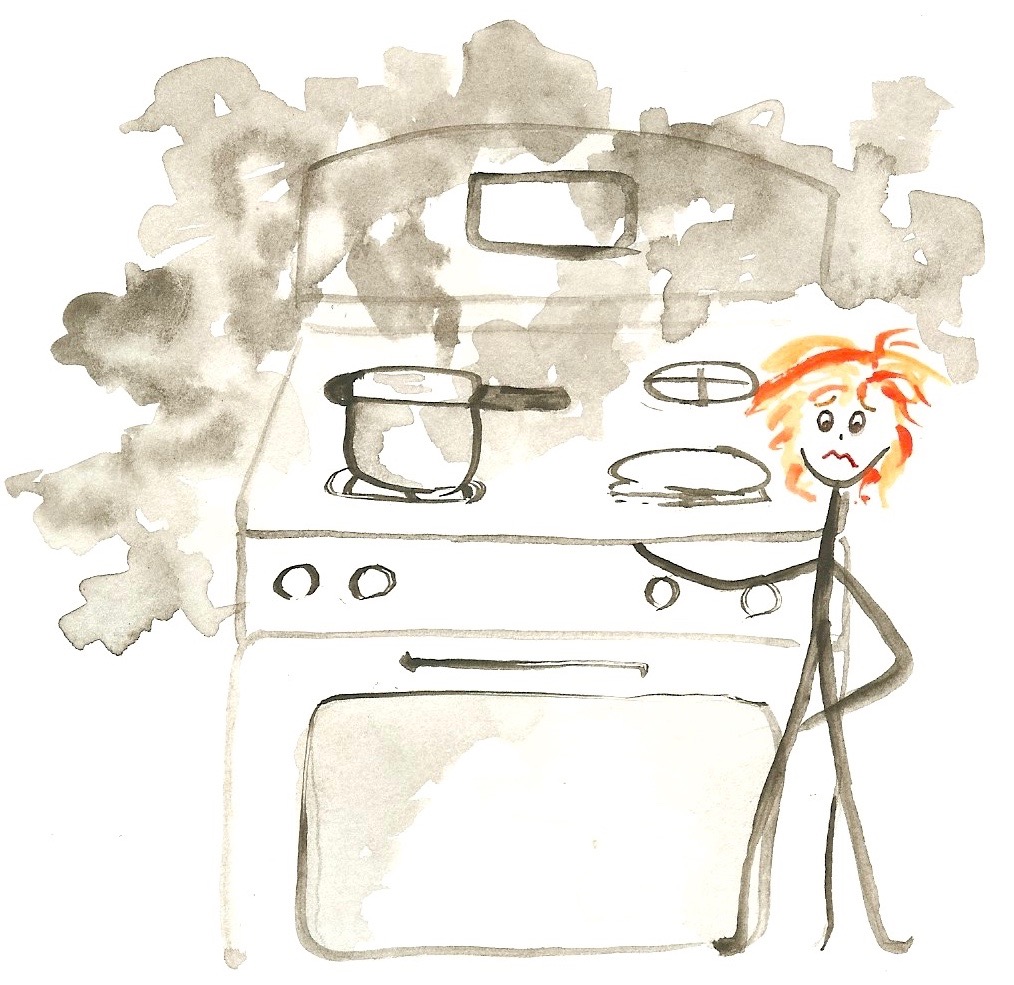
Their video shows a happily sizzling roast in the pan. I set my timer for 10 minutes. After about 5 minutes, the dining room was filling with smoke. At 8 minutes, I opened the windows. At 10 minutes, the bottom of my pot was black. I was following the recipe; I thought this was what meat did!

I added all my onions and garlic and mushrooms. I was then up to “deglazing,” which (after further Google research) means “scrape up all the good stuff stuck to the bottom.” I was supposed to do this with a wooden spoon. Which is pretty much impossible when the bottom is thick, black, and impenetrable. When the bottom looks like hardened lava from a volcanic eruption. Something was not right here….

Nevertheless, I persisted.

Even now, I can’t figure out what I did wrong. Was I supposed to go less than exactly 10 minutes or have my pressure cooker not as hot as it could be?

In the end, the meat was cooked just right, the potatoes and carrots done to perfection. Flavor good … for meat. Tim liked it.

But the bottom of the pot was totally, unrelentingly black. I, of course, returned to the Internet.

This is like the time I checked Google for what to put on burns. I sunk down the rabbit hole of blackened pot remedies. Since then, my pot has experienced:
  • Boiling with dish soap in it
  • Boiling water and equal parts vinegar (with and without the addition of baking soda)
  • Baking soda paste
  • Coca-Cola
  • Massive doses of elbow grease
  • Steel wool, which some YouTube videos promote and some decry because it scratches the steel – hey, we are well beyond worrying about scratches….
Tim offered to put a steel brush on his drill and have a go at it, but I have yet to add the OxiClean or the dishwasher powder or the tomato sauce. My friend Riki suggested Mr. Clean’s Magic Eraser, whose miracles I have chronicled here, so he’s next on the list. The YouTube people try their remedies and show off newly sparkling pots, but I have also followed poor Peter’s efforts, who – with the help of loyal commenters – seems to have run the gamut of tips on his pot, too.

One loyal commenter told Peter to just accept his pot as “seasoned.”

And so the pressure cooker teaches me yet another lesson for life in The Parable of the Pressure Cooker: What can’t be shiny and new is … seasoned.

Thursday, February 9, 2017

Cutting the Mustard

This was one of those days when all I wanted to do was sleep. Even after a rare good night’s sleep, I was ready to sleep some more. I shoveled the driveway. Shoveled it again, and REALLY wanted to sleep some more. I felt like I was in a holding pattern just till I could sleep again.

But as I was dropping off some books at the library, I spotted a sign: “Medieval Mustard.” Even the librarian had to look that up. Turns out it was a program that night in mustard-making: “Mustard-making kits will be available. Ready your whomping arm and come make the mustard.” We had to look up “whomping,” too. Could my snow-shoveling arm still whomp?

After dinner, the agony of choice: sleep or try a New Thing? The couch or the road? The Lounge or Col. Mustard? As always, curiosity was the great decider: What’s in a mustard-making kit anyway?

This being Anchorage, fifteen mustard makers would have to include one friend I hadn’t seen in years. Kerri and the others are part of the Society for Creative Anachronism (the Renaissance Fair-type people) so we had a whole lesson in mustard. 13th century households would consume between 160 and 190 gallons of mustard a year!

Our teacher, Nicole, was a master of preparation. We had our histories of mustard, our recipes, our supplies, and our mustard-tasting options. Mustard-making is even easier than sauerkraut-making!

We added wine to our ground mustard seeds, a bit of water, and our choice of herbs. All in a big red cup. Then we whomped.


(Whomping is stirring with a plastic fork.)

Then it sits for 20 minutes. Then you have mustard!

During our 20 minutes, we tasted mustards. Chinese mustard had zing, whole grain mustard had texture, honey mustard was sweet, and the yellow mustard was awful. (Nicole had added jalapeños to it to liven it up.) Her recipes include strawberry mustard, molasses mustard, mustard with Worcestershire sauce, mustard with Tabasco and horseradish. Mustard with white wine, mustard with red.

One can go nuts with mustard options!

Our salad dressing used to come in a bottle named Annie’s or Kraft or Wish-Bone. In fact, I just discovered some very old Ranch dressing envelopes in the kitchen cabinet … for when I was getting earthy and “making” our own. A few years back, Sophie taught us to make vinaigrette and add mustard as an emulsifier. Ooh, that was revolutionary; we took to whisking up fresh salad dressing each night.

Ah, but now I’ve discovered the big, wide world of mustard.

Salad may never be the same again. Not hot dogs either.

Monday, November 7, 2016

Who cooks dinner?

So let’s say you enter your Third Third earlier than your spouse: who does the cooking?

Do you:
  1. Do more of the cooking because he/she is still working (and earning income) and wouldn’t it be nice for them to come home to a hot meal? (with pleasure)
  2. Continue to share the cooking/household chores because you worked hard to establish an egalitarian household and you’re committed to that in your relationship? (with pleasure)
  3. Do more of the cooking because … (same as #1, but with resentment)
  4. Continue to share the cooking/household chores because … (same as #2, but with resentment)
I know there are some people who are delighted with their newfound time to cook and prepare meals. Those are the women who lined up at the Friends of the Library book sale in front of the cookbook shelves. Those are the folks who take photos of the meals they’ve prepared and post them on Facebook. (Yes, I do know ONE MAN who does this.)

I’m not those people. Mostly, I kind of forget about eating until I have a headache, BUT when I cook, I like it to be healthful, non-meat, and not processed. That takes time. This is the weekly cycle we’re on:

Monday: I cook delicious healthy meal with side dishes. I have to stop what I’m doing at 3:30 for this to be possible, but I am pleased with my effort, and my efforts are appreciated.
Tuesday: I cook delicious healthy meal with side dishes. I have to stop what I’m doing at 3:30 for this to be possible, but I am pleased with my effort, and my efforts are appreciated.
Wednesday: I have to make extra trips to the store for a missing ingredient that is not in stock at two stores (corn meal!?). This particular meal turns out to have a few more steps in it than I’d anticipated so my day gets eaten up with meal preparation. I decide husband is not properly appreciative. I have to stay up late to get my personal stuff done that I couldn’t get done during the day.
Thursday: I assemble a meal of delicious leftovers. I watch husband like a hawk, evaluating whether he is eating his way through the leftovers so we won’t get another meal out of them. I fill out angry survey form for grocery store that did not have corn meal in stock.
Friday: Husband is picking up on clues. He starts saying things like, “I’m making a list with some items I want to cook for a meal. Do you have anything to add?” I feel bad because he has contributed 40+ work hours to our household this week and now I am frightening him back into egalitarianism because he knows me and knows I am ready to blow. I feel very grumpy about all this, but I did not quit my job to cook dinners.

My husband and I had achieved a very nice balance during our working years. He did things; I did things. We both parented. Every now and then, I’d get miffed because my things were do-over-and-over-again things and his were big-project-achieved kind of things, but we worked out a balance of effort. I’ve never mowed the lawn; he’s never tended the garden. If something broken required glue, he fixed it; if it required sewing, I fixed it. We rotated regular meal preparation, but mostly he cooked food, and I cooked meals. Things felt even.

But now, I have more flexible, “leisure” time. And in talking to many women friends, that creates a guilty burden of “we should be” cooking dinner. And the problem with guilty burdens is that eventually resentment finds its way in. I’m sure my husband would say I shouldn’t feel this way, that I’ve earned my time, that I contribute to the household (if not at the same income level as before), but that’s because he’s nicer than I. He’d also say peanut butter is fine for dinner.

So other than giving myself a personality transplant (attempted, never successful), I’ve been trying to come up with solutions to the perceived Dinner Burden:
  1. Maybe peanut butter, yogurt, or whatever scrounging yields can be counted as a meal. Maybe dinner-as-meal is a Second Third thing. Maybe Third Third dinner needs to be re-imagined as bits-of-this-and-that, not a whole meal, but still sitting down together. Maybe a dinner meal can then be a surprise kind of thing, as in “Oh! You made dinner! What a nice surprise!”

  2. Browse my magazines and collected recipes and get enthused about cooking one of those creations?

  3. See a lot more movies at the Bear Tooth and eat dinner there?

  4. More giant soups, more salmon, sandwiches? Great volumes of leftovers? Start a recipe folder of “easy”?
Taking suggestions….

Wednesday, September 28, 2016

A Recipe for Clutter

Years and years ago, I had accumulated enough recipe clutter that I needed a way to organize it. I took an empty photo album, added tabs for the sections, and slid the recipes under the plastic. The tabs say things like “Main Dishes,” “Salads,” etc. The binder is big and red and full of favorites.

Well, not big enough. There are no more empty pages.

Now, when I tear a recipe out of a magazine, it has no clear destination. It sits on the counter for a few weeks, awaiting relocation. (Along with all the other clutter-orphans awaiting their own relocation.) Recipes are a recipe for clutter. Eventually, I stuff them into the front of the big red binder. Loose. Now the big red binder is REALLY big.

But it’s an unstable kind of big. Unstable as in when you pull it off the shelf, all the loose magazine clippings fall out all over the place.
Something had to be done.

So I sat down one day and culled the recipe pile. Created a big recycling pile and a little pile of sorted recipes. (In your Third Third, you know you are NEVER going to make something requiring more than five steps….) I put them in folders, but this time – after years of cooking – I had more specific categories: Pasta, Vegetables, Rice and Grains, Salmon. Eleven relatively thin folders. Plus one folder titled “Favorites,” those things that we dub: the repertoire.
And then it occurred to me: What if eggplant were in season and I wanted to cook with eggplant? What if the eggplant recipe was in Pasta or Rice? How could I find it? Pasta comes with other ingredients – how would I find them? And what about the wheat berry salad; does it go with Grains or Salad?

My friend Judith says the only solution is to make an index. She’s making an index. To me, an index is more than a to-do list item; it’s an insurmountable hurdle. It would need constant updating. Before I’d get to that, I’d make a list of all the movies I’ve seen so I’d stop coming home from the library with DVD repeats I don’t remember….

So I took the dilemma to my friend Sharon-of-the-400-cookbooks. Sharon has two file cabinet drawers of folders. Over time, just as I’d discovered, the categories refine themselves. Sharon’s “Meats” split off into “Beef Brisket” and “Lamb.” “Soups” spawned “Tomato Soups.” She has separate folders for “Avocados” and “Dates” and “Asian and Curries.” The problem Sharon is facing is that her favorites file is now two unwieldy files thick so she has to figure out some way of culling it.

Then I took the dilemma to my friend Marj. I’d remembered that Marj had a meticulous shelf full of white binders neatly labeled with her categories. Well, the four feet of binders is now eight inches of folders – a de-cluttering victory for Marj!

Marj sorts her folders by function, not by ingredients: “My big confusion is does beef stew go under Beef or under Stew or under Slow Cooker. Again, I look at the function – if I want to make a Crockpot meal, I only want to make a Crockpot meal, so everything Crockpot goes into one Slow Cooker folder, regardless of ingredients.”

All of us – good de-cluttering Third Thirders – are going through our cookbooks, identifying the keepers, copying them, and donating the cookbooks. In the meantime, Sharon puts flags on her cookbook pages. I’m going to start doing that because a good recipe tends to get lost in a closed cookbook, but Sharon even keeps a Dinner Party Journal citing the page numbers and cookbooks of what she prepared.
In my mother’s Third Third, when her last child left home; she ate out, brought home leftovers, and stopped cooking.

What’s your recipe for de-cluttering recipes?

Thursday, September 15, 2016

Sauerkraut Fever

Hooray, I made sauerkraut! Delicious sauerkraut! This is definitely a red letter, New Thing day.

Sauerkraut is fun, sauerkraut is easy, sauerkraut is magic! It’s a sauerkraut jubilee in our house.

When I was little, I had terrible stomach pains. After a few years of this, we went to the doctor. He asked about my regular diet. I’m not sure of the specifics, but his answer was something like, “human beings shouldn’t eat that much sauerkraut,” and I was forcibly removed from the sauerkraut jar.

When I moved into my first apartment, I remember being thrilled that I could bake a potato whenever I wanted in my own oven. And I could heat sauerkraut on the stove and eat it warm (which was a relatively new discovery of mine) whenever I wanted. I felt such ownership of my life!

But then somehow – I don’t know how it happened – sauerkraut fell off the radar. It only reemerged on the very infrequent hot dog.

Nevertheless, at the State Fair a few years ago, I took a class on making sauerkraut. It was so complicated and intimidating that sauerkraut-making never made it on my list.

And then my friend, Connie, said she makes it, it was easy, and why didn’t I come over? So first I picked up three cabbages at the Farmer’s Market, three heads of garlic, and some carrots.
We used Connie’s little hand-held slicer thing (which was a little scary since I have a difficult relationship with sharp objects), but the idea was to get skinny little shreds of cabbage and no blood in the mix. When I finished half a head of cabbage, I put it in a bowl and sprinkled it with a little salt. When the bowl was full, I squeezed it and mashed it and rubbed it against itself till water was oozing out everywhere. It was very hands-on; if I weren’t the one doing it – if I were only watching – I would beg to try.

Then I cut up my garlic and the carrots and threw them into the mush bowl.

I’d brought along some wide-neck jars, and I put my cabbage into them. Connie took one of the outer leaves of a cabbage, folded it around, and laid it over the cabbage. She mashed it down, creating a boundary so cabbage would be submerged under it with water on top. She screwed the top on, then backed it off a little.
And that was it! Each day, I just had to open the jar, mash down the big cabbage leaf so that more liquid would rise to the top, close it back up, and leave it.
It’s called wild fermentation, but it seems like magic! Way easier than my adventures with raspberry liqueur and even more fun than my spiralizer because at the end, I get sauerkraut! Handmade. By me! I feel like such an Earth Mother – hippie fantasies realized.

Today, I cased thrift stores for a crock so I can make bigger batches. Saturday, I’ll be at the Farmer’s Market buying up cabbage. Tonight, I’m a glutton, eating sauerkraut by the forkful.

I’d been focusing lately on trying to feel “abundance” in my Third Third. Who knew it would take the form of sauerkraut? It could be worse; it could be donuts.

Sunday, August 21, 2016

Invasion of the Vegetables

I never thought I’d find this week’s New Thing at the Farmer’s Market, and certainly not a Scary New Thing, but here it is:
It’s called Romanesco cauliflower, and it’s enough to keep me up nights. It looks like something prehistoric or extraterrestrial. I don’t think I can actually get up the courage to eat it. It would grow aliens inside my stomach. Last year, when I discovered that Brussels sprouts grow on stalks, they looked magical. The cauliflower: frightening.
The Farmer’s Market was such a display of abundance! It’s not even that my head of Romaine lettuce is the size of a laundry basket or that one bunch of Swiss chard can take up a car seat. The giant zucchini are making their appearance – yikes, there are even Romanesco zucchini! And now there are so many varieties of heirloom tomatoes: Black Krim, Green Zebra, and Chocolate Stripes. But my favorite name is the Mortgage Lifter Tomato.
There’s a build-your-own bouquet flower stall and Wild Scoops ice cream. The fish guys, the sprouts guys, the bread folks. One sign said, “Distressed Gingerbread Cookies, $1/pkg.” I had to ask. The answer, admitted the bakers sheepishly, “No, they’re not unhappy. They’re just not … up to par.”
The musical entertainment was lovely, but all the entertainment I need is to watch Karl of La Grassa slice fresh pasta. He lays out the sheet of perfect pasta, folds it meticulously, and then slices it cleanly. He peels a tab back from the fold of each slice, lifts it up, and shakes the pasta loose. I could watch it for hours.

Special last Saturday, Alaska Farmland Trust had a tent set up for tasting vodka and vodka-inspired food. Clayton, the chef, said he was given the vodka to taste and then he created the dishes: “Heirloom tomato Bloody Mary salad with ghost pepper vodka” and “Spent grain bacon waffle with blueberry vodka whipped cream.” Not much of a drinker, I had the Forget Me Not blueberry vodka with organic lemonade. But then, after a sip of Glacier Melt Vodka, I felt loopy and had to have more of Clayton’s “Potato latkes and smoked salmon with Yensis onion jam.” I just had to. I was driving.

I’m not a foodie. I don’t take photos of my food or look for fancy, creative selections in restaurants. When I buy a potato, it’s either smooth, baking, red, or sweet. But at the Farmer’s Market, there’s Yukon Gold, Lemhi, Magic Molly, Huckleberry, Doc’s, Allagash, and German butterball.

The sun was shining, the music playing, and all around me were bushels and bushels of vegetables and healthy food. Everything was just so HEALTHY and fresh. Friends said hello, and I thought, things don’t get better than this.

Sharing Button