Pages

Showing posts with label rituals. Show all posts

Tuesday, May 10, 2022

Goodbye, Toronto

I’m saying my goodbyes to Toronto. I’ve seen my last Hot Docs Festival film, and I’m just back from my last author program. I’ve probably had my last roti, checked out my last book at my local branch library, gone to my last art workshop. Horror of horrors, I’ve even watched my last play.
 
The thing about my Urban Infusion Months is that I get attached. I embrace my new city – even my new neighborhood – and then I feel such nostalgia over leaving it. I leave little bits of me and my experiences all over.
 
When I first arrived and wrote my last post about the thrill of being a little bit scared, a little bit curious; my friend Helen replied, “How are we friends when we’re so different?! Reading this one made me realize how much I now like creating new routines and avoiding confusion!!”
 
As I told Helen, “I definitely create new routines. It’s just that they’re new routines, not the same old, same old for the past 35 years!”
 
So I’d start off every morning checking blogTO to see what new things they’d found for me. And I’d stop off at my Riverdale Branch Library where the librarian posted a new poem every day of April for Poetry Month.

Many nights, I’d catch The Great Canadian Baking Show – four seasons’ worth! – after I figured out the TV remote. I learned that Montreal-style bagels have bigger holes than New York bagels and they’re boiled in honey water instead of plain water. They look scrawny and burnt as opposed to New York’s plump and golden, but that honey water holds a LOT of garlic and onion. So when blogTO announced the opening of Kettleman’s Bagels, I headed down there to check them out and watch the bakers in the window. I do that a lot. A half-dozen bagels are coming back to Alaska with me.

I learned where the Apple store was when my external hard drive crashed, so I knew where it was when Tim lost a cable. Around the corner, Yael has put the recipe for my hair color in the files so she can repeat it. When I discovered that Nova Era Bakery in Little Portugal has a wonderful little café in back, I took Elizabeth and Tim there, too. It’s my new “Spot,” right near Galo de Barcelos.

I have my favorite FreshCo, my favorite COBS Bread, my favorite Bulk Barn, even my favorite Dollarama with my favorite licorice. I have my favorite streetcar (although Tim insists I’ve never met a streetcar I didn’t love). I have a tried-and-true walk up the hill to the subway, and I know where the bad puddle exists permanently in Riverdale Park. I even have a favorite spot on the couch in the apartment living room.


Still, no one sits next to anyone on the TTC yet, and there’s even distancing spaces in theaters, so my salvation has been Meetup: Walking Adventures with Deb. Several times a week, Deb leads us through the nooks and crannies of Toronto to the glorious greenery of the ravines, paths, and rivers. We’re outdoors and unmasked and walking and talking. Siobhan, Penny, Anna, Phyllis, Janet, Alison, and so many other welcoming folks made such a difference. I see what’s ahead on the calendar, but I won’t be here.
 
On Sunday afternoons, the Danforth Jewish Circle let me be a part of their Jewish community and their art workshop to create a print for a tapestry for the sanctuary. Now I’ll only see photos when it’s finished.


In all my reading and conjecturing about parallel lives and multiverses, I think about all the branches of my lives that take off after I’ve left them. There’s the Anchorage Barbara, the Toronto Barbara, the New York Barbara, the San Francisco Barbara, and even the Costa Rica Barbara. If I’d stayed in one place, I could hold my life close and let it continue. But by starting new lives in several places, I have to let them go.
 
This is the sweet and sad part. I have to let them go.
 
Because there’s another part of me that wants to lie with Tim on our back deck in Anchorage and look out over the yard that’s held barbecues and potlucks, croquet games and badminton games, Sophie’s playhouse and once-healthy spruce trees. To bask in all the history of 37 years in one spot.


Sunday, February 23, 2020

Why I Light this Candle

Monday night was my father’s yahrzeit, and I lit a candle.

He died in 1980 on the 23rd day of the Hebrew month of Shevat, February 10th by the American/Gregorian calendar. Since the Hebrew calendar follows a lunar month, the date shifts around every year, and I have to check each year to find out when Shevat 23 lands.

The candle is a special candle that burns for about 26 hours. I light it at sundown the night before his yahrzeit and I say Kaddish, a Hebrew prayer of mourning. Then I take a photo and send it to my siblings and my daughter.
My brother replied: “Saying kaddish? Praying? Do you guys do that? Is the religious aspect of Judaism important to you all? Do you believe in the Jewish God? Or any god?”

These are all good questions. I only started lighting the candle a couple years ago, so why exactly do I do it?

First, there’s the God part. I have a physicist’s view of the universe. Einstein and Hawking and Feynman and Thorne are my source material, and while I marvel at the amazing answers science has been able to provide, I am in awe of the unanswered questions. The mystery is what thrills me, the unknowable (so far). That mystery is what I might feel God-like (or physicist-like?) about.


So that really doesn’t have anything to do with “belief.” Or “higher powers” or the usual ideas about God. Prayer is a melody, not a request or a hope. It doesn’t do anything.

So if I’m not lighting the candle for God; am I doing it for Dad? Well, Dad is dead, and he has no idea I’m lighting any candle. I also tend to skip the part about telling stories about him, remembering him, reflecting on him. My Dad had a difficult childhood with ideas of parenting I have since rejected, but I made my peace with him. So I don’t think I’m lighting the candle specifically for my Dad (even though it’s his yahrzeit).

I am lighting the candle because I am part of a line. Other people lit candles for parents and grandparents and I am a daughter and it’s my turn in the line.

I didn’t really understand this line until I had a daughter. She was named for my grandmother, but she extended my line into the future. That’s a really earth-shaking realization – a total transformation of reality – and once you’re extended into the future, your link to the past is cemented, too. In our Third Thirds, it all seems so much clearer. That past comes with tradition, history, and ritual. In my pick-and-choose way, I pick the candle ritual.

In my case, the tradition is Judaism. This is what I believe: whatever you are, however you identify yourself, you have to be it wholeheartedly. You have to affirm it, learn about it, be proud of it, espouse it. At the same time, you have to enjoy that everyone else is affirming, espousing, and proud of what they are. If we don’t do that, we all become just white bread.

Ursula K. LeGuin wrote a fascinating book called The Lathe of Heaven. The protagonist has “effective” dreams, meaning they actually alter reality. A psychiatrist tries to steer his dreams to solve world problems, such as racism. But as dreams work, George dreams that everyone is now gray … and his girlfriend no longer exists. Being black was such a powerful part of her identity, she couldn’t exist in a gray world.

A gray world, a white bread world, is a world I don’t want to live in. I want big, vibrant African-Americans; big, vibrant Puerto Ricans; big, vibrant Norwegians (recognizing that might not be their style…), etc. etc. And my contribution to this is as a Jew.

So this is why I light the yahrzeit candle: I am reaffirming my place in the Jewish line of my grandparents, my father, my family, and my daughter. I am honoring them and our tradition, and I am being who I am. That’s all.

Tuesday, October 1, 2019

Word Wars 2019

When it’s autumn, you know I’m spelling and pronouncing words and Werd Nerd-ing for the annual BizBee, the Alaska Literacy Program’s annual adult spelling bee. Now it’s time for the less-than-instant replay.

Setting the stage for BizBee skill were our highly-qualified judges, three retired kindergarten teachers – the “Killer Bees.” Taking up her usual position of more than ten years was the “Human Dictionary.” Patricia provides precise pronunciations when teams either (1) distrust my New York accent or (2) are stalling for time. She received more requests for re-pronunciations this year than in all her previous years combined! And teams started a new thing: asking for “word origins.” Just playing for time….
All teams made it through the first round, even with a ridiculous word like mizzle (a cross between mist and drizzle). A climatologist in the audience pointed out that it’s an archaic word, never used anymore. What kind of words does he think spelling bees are made of?

But alas, our Distinguished Leaders in Literacy, the “Elemenopees” of First National Bank Alaska, gave way under pressure to yieldable and picked up the Red Lantern Prize. What can you say about a round that gives the Anchorage School Board team the word curriculum? (It’s just luck.)

What distinguished this year’s BizBee? Full bladders. To maintain the fairness of the competition – just in case a team has hidden dictionaries in the restrooms – if one person has to use the restroom, everyone has to take a bathroom break. This year’s BizBee included a record number of restroom breaks! How’s that for a wild night!

But it wasn’t until Round 3 that the carnage started building. The only thing worse than looking at kohlrabi is spelling it, and ServiceMaster suffered that fate. And because the BizBee came in September, the “Phrequent Phliers” of the Alaska Airlines-sponsored ALP volunteers, weren’t prepared for Oktoberfest and lost their pants on lederhosen. But wait! They pulled out the TeamSaver, the secret, one-of-a-kind, Get-Out-of-Jail-Free card for having sold the most raffle tickets. They were back in the game!

No such luck for ConocoPhillips. They may be a Distinguished Leader in Literacy, but their back went out on notochord.

In Round 4, “Pun with Words,” the ALP Board of Directors team, marooned themselves on the archipelago. Alyse for Alaska (featuring candidate Alyse Galvin) wasn’t going to go down easy: they cringed and flattered their way out of gnathonic by passing it to the Anchorage School Board team (who didn’t want it either). Then they mailed off philately, too. Every passed word means more donations to the Literacy Program, but the danger is the replacement word: what if it’s harder than the one you gave away? The heat was on, but they could handle Fahrenheit (with the same cheer that eventually won them the Outstanding Spirit Award).

Only one miraculous rescue is possible, so Round 4 ended with the Phrequent Phliers stopped at the gate by durwan.

Round 5 and Summit Spice and Tea were too explicit for euphemism; Alyse for Alaska lost blossoms on Hemerocallis; the “ALPabets” were carried off to Africa by roodebok; and the “Health Literacy Heroes” of Providence choked on kielbasa. It was an all-out team train wreck.

Round 6 knocked out the biological clocks of MSI Communications with zeitgeber, and witloof poisoned the salad of the DOWL team.

There’s always a moment in the BizBee when the judges and the Werd Nerd have to figure out how to avoid a midnight contest. How do we spell teams out so we’re not there all night? We have to advance on the word list. “Oh, no!” shout the MENSA cheerleaders. “Not #715!”

But it was word #716 that would have drowned the whole crowd: liman (especially hard if you consider it’s pronounced lē män) was passed by five teams. With no more teams left to receive it, it went into oblivion, sunk into the lagoon of its name.

Ravens’ Roost moved too slowly for tardigrade, and the School Board (the last rookie team standing) had no divine connection for afflatus.

So now it was down to the Big Three: 2018 champions Arctic Entries; 2017 champions Holistic Hands (the Rosie the Riveters); and runner-up both years the Anchorage Unitarian Universalists “In Fred’s Name” (for longtime literacy volunteer Fred Hillman).

Arctic Entries lost in the upheaval of geanticline, and the Rosies drowned in the chresard, but could the wildly-colored Unitarians escape their runner-up fate? After years as #2, could they finally claim victory? They successfully launched their Siamese fighting fish betta, and now one word stood between them and victory. With a sharp gravette ... they took the championship!

Thursday, October 5, 2017

Ready for the Big One?

In the wake of all the Nature-made disasters that have befallen the world lately – Puerto Rico, Mexico, Florida – the subject of “being ready” has come up. At one dinner, one friend went through all the supplies his neighbors have gathered: one has a year’s supply of food, another has 10,000 rounds of ammunition. His wife said, “I have craft supplies.”

I have craft supplies, too. All the women at the table had craft supplies.

Our neighbor says he’s ready because he has a Prius. My husband said that might buy him two days over the rest of us, but I’m not sure how far he’ll get … or what he’s actually ready for. His back stairs fell down so he doesn’t even have a second exit.

Are you ready?

Well, I was once. When Sophie was a baby, Tim fixed our bookcases to the wall so they couldn’t fall on her (never mind the books), and I stocked the pantry, identified the flashlights, filled water jugs. But after a while, I gave up changing the water, the batteries in the flashlights corroded, and maybe we ate some of the supplies. Then I figured we could just raid the closet with the camping gear – at least we have camping gear.

But now, as I look around me, I realize that with the new-carpet-relocation, bookshelves were moved, and they’re not anchored to the wall anymore. In fact, come the earthquake, if I’m at my computer, I’m squashed. Squashed by craft supplies.

So why am I bothering you (and me) with this issue that gives rise to a massive avoidance response? Avoiding the horrendous “to do” lists of identifying hazards, organizing emergency supplies, even gathering important papers? Just give me some sand to stick my head in.

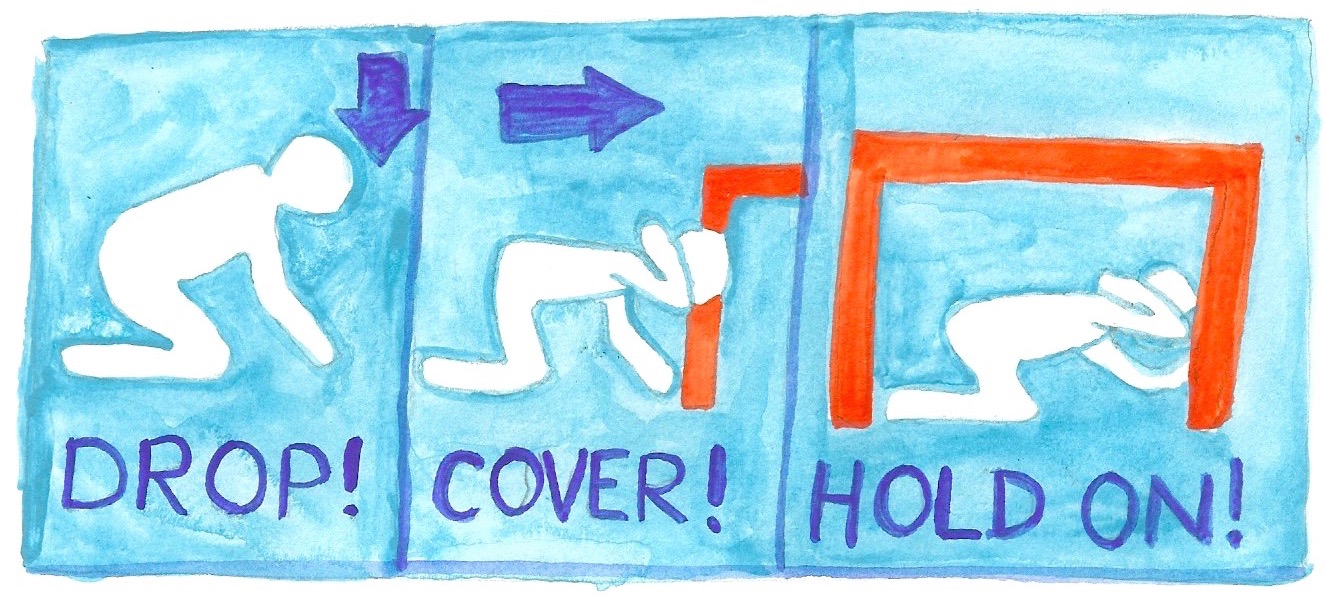
But Thursday, October 19 is the Great Alaska ShakeOut. At 10:19 a.m., all over the U.S., millions of people will be dropping, covering, and holding on in the world’s largest earthquake drill. I do it every year. It’s a fun way to remind us – wherever we are on that date and that time – however inconvenient it is – that earthquakes are inconvenient, too.


Even if I manage to avoid the pre-drill recommendations (those readiness checklists), I still look around my 10:19 environment: What’s going to come crashing down? What protection is immediately accessible? How do I get away from windows? Call it my exercise in mindfulness….

And then, of course, there’s the theater of it. The website provides sound effects you can put over a P.A. system, but I’m kind of partial to the air horn shock to the system. Then picture everyone scurrying and climbing under tables. At the Literacy Program, there are people who have been in scarier earthquakes than I have – earthquakes in places without building codes – so our preparation will probably include some good stories, too.

So even if you haven’t stored your gallon of water per person per day for three days; met your self-sufficiency requirements for up to two weeks; or even own a crank radio – even if all you have are craft supplies – you can remember what NOT to do:
  • Do NOT get in a doorway (old myth)
  • Do NOT run outside
  • Do NOT believe the so-called “triangle of life” (new myth)
Just Drop, Cover, and Hold On with 100,000 other Alaskans. Sign up today and I’ll meet you under the table.

Sunday, September 10, 2017

Of Tea and Adirondack Chairs

About the tea thing. About why Happy Uterus Tea would even show up on my radar.

Tea is a symbol.

Tea is the Adirondack chair of my life. The Adirondack chair figured in an essay I read once years ago: a woman bought Adirondack chairs because she had visions of pouring lemonade, setting the glass on the wide arms, relaxing and enjoying life. I have that same fantasy, but in mine, I’m sitting and drinking tea.

The woman in the essay got rid of her Adirondack chairs years later, because she’d never sat in them.
I may not have Adirondack chairs, but I have a lot of tea paraphernalia. I have beautiful teacups, I have teaspoons, tea party place cards. I even have a penguin in a tuxedo who lifts the tea bag out of the cup after three minutes have passed.

My daughter and I had tea parties. She collected tiny tea sets. Lots of them. I’ve moved her tiny tea set collection several times during room relocations, carpet removal, carpet replacement. I know her tiny tea sets intimately. Much of the tea paraphernalia we collected together.

The beautiful teacups were a gift many years ago from a friend. I let them sit in the cabinet for years because they were the “good” teacups. They were waiting for special occasions while we drank regular, no-special-occasion tea from no-special-occasion mugs. Those teacups waited a long time … till I learned in my Third Third that life was meant to be enjoyed now and waiting is a misguided gamble.

The tea vision involves having women friends over to drink tea with me (and my teacups and my teaspoons and my penguin). That meant I needed a large enough teapot to fill many cups of tea. I searched and searched for one for years, and finally found one at a crafts fair in Massachusetts. It’s beautiful.
It’s the teapot I made the tea cozy for, the “tea yurt.”
And then I went to London, where people sit down with their tea no matter what. On Masterpiece, the characters are always offering each other tea for distress and trauma, illness and worry, and it works! In London, I tasted tea at Twinings and bought the most delicious Ginger and Sicilian Lemon “silky bag infusions” at Fortnum & Mason.

So this is what tea is: it’s a vision of a life of friends, of conversation, of quiet, of appreciation for now. Of special moments, of finding calm, of a daughter’s enchantment, of sharing in another culture. Of finding something beautiful, creating something new, of trying out new tastes.

In my Third Third, tea is way more than just worrying about all the peeing afterwards and whether I’m near a restroom. And what to do because everyone else drinks coffee.

This is the bigger Third Third question: Do I actually sit down and drink tea? Do I actually let myself enter that tea drinking mental space? (sigh…) I’m more like the woman in the essay not drinking lemonade in her Adirondack chair.

My Third Third is always a work in progress….

Tuesday, June 6, 2017

Lessons of a Third Third Garden

I know many people who relish their Third Third because it gives them more time in their gardens … and their gardens reflect that. I love their gardens. I go on tours of their gardens. I marvel and compliment and ooh and envy. I write down names of plants. I buy them.

Then I go home to my dirt.

I was going to wax funny about my garden difficulties, my scrawny plants, my fight against invasives, my slugs. This was going to be a ha-ha-ha-woe-is-me kind of blog post. But as I thought about my garden, my perspective shifted in a very Third Third way. My garden was echoing some of the lessons and gifts my Third Third has given me. See if you know what I mean:
  • When I water a plant, I feel it drink. If you don’t know this feeling, I can’t describe it. I am nourishing something and enabling it to live.


  • Every flower has its moment of glory. Yes, mostly my flowers have only moments, but they’re still glorious. The Oriental poppy is big and bright till it isn’t. The peony is spectacular till it droops. The daisies are a sea of white till they’re scraggly. But they all have their moments.


  • Every now and then, there’s a surprise: the daffodils that have come up for 25 years and never bloomed produced one bloom this year! I don’t know why. Maybe it just needed more time.


  • For years, on tours at the Alaska Botanical Garden, I’d taste the sorrel and want to add it to salads. Last year, I finally found a plant for sale and bought it. This year, I noticed it’s back! I am getting this gift again! I didn’t know it would come back, but it did.

  • Years ago, after Sophie and I read Miss Rumphius, Louise and Richard called to say they were digging up their lupine, would Sophie want to come by and get some plants. Miss Rumphius committed to making the world more beautiful, so she planted lupine everywhere. Every time Sophie’s lupine grows, blossoms, and spreads, the world is more beautiful.
  • The back of the house has giant white columbine. One year, one plant produced bright purple flowers. How did that happen? Some years, there are yellow columbine, some times purple again. It is a mystery.


  • My flowers are scrawny. They just aren’t … exuberant. Except one area where a flock of pansies somehow got happy and come back every year. Again, it’s a total mystery how that happens. I don’t know how to repeat it, but it just repeats itself. My happy flock of pansies.


  • I let mint grow wherever it wants (within reason). It fills in my blank spaces and gives me fresh mint for salads. It is pure reward for no effort.


  • One parsley plant solves the problem of needing a bit of parsley for a recipe but not having to buy a whole bunch at the store (which will only go bad).


  • When the lilac is in bloom, every step outside is filled with fragrance. I remember that I have a sense of smell.
A long time ago, I took a lobelia basket class at the Alaska Botanical Garden. We lined a wire basket with black plastic and poked about 35 holes in it. We took a little lobelia start out of its little pot and rolled a piece of plastic around the plant, leaving the root ball hanging. We pushed the plastic tube through the hole in the basket from the inside and tugged till the dirt clump stopped it. (Or till you broke it; accidents happen.)

So then you end up with a basket that looks like a bunch of frightened lobelias. In the top, you plant yellow marigolds.

Eventually, they grow and get bushy and – supposedly – you end up with the giant Alaska-flag-colors, blue-and-gold hanging planters that decorate Fourth Avenue downtown.

Mine don’t ever get like that, but they do get pretty. So every year, I re-use my original baskets from years ago and make two more. They are my big effort/big reward gardening victory. They hang by my front door, and I notice them, pay attention to them, marvel at them every time I come and go. Ah, that’s what a garden does!

Wednesday, October 19, 2016

Life and Death Lessons

Things I’ve Learned in the Last Week, or Growing in My Third Third:

I learned that losing a parent is painful.


Yes, yes, I knew that, but I didn’t KNOW that. It’s like when I first had a baby. Suddenly I felt like I needed to apologize to every friend I knew with children. I’d had no idea it could be so HARD. I didn’t know about the sleep deprivation, the worry, the demands on your time. I didn’t know about the disruption to life-as-you-knew-it. I didn’t know that finding the right childcare was so hard, that you’d be torn emotionally in so many different ways. These were abstract facts to me, not life-wrenching realities.

The same is true with losing a parent. I’d offer condolences, but I didn’t offer CONDOLENCES, if you know what I mean. I didn’t know you’d be shaken to your core, that the shaking would last and last. That anyone could be this sad.

I’m sorry. I didn’t know.

I learned that expressions of sympathy and comfort make a huge difference.

Yes, it was right here in this blog that I made fun of greeting cards: “NO ONE looks at old greeting cards.” But I didn’t know the power of new greeting cards. Returning from my mother’s burial, picking up the held mail at the post office, I was moved by the sympathy cards. I was moved by the cards that came from people relatively distant in my life, from my past, from my synagogue. It made me feel part of a community. They took time out of their lives to comfort me.
I was moved by the phone calls, the visits, the hugs. I was moved by the comments, the emails, the “loves.” I was honored by all the requests to help. It reaffirmed me as a member of the larger community of human beings: we all hurt, we can all comfort.

When she was little, we never let Sophie play with or wear a gift until the thank you note was written. We wanted to teach the necessity of demonstrating gratitude. It didn’t occur to me that I should also teach – and learn – the necessity of showing support.

My sister has said the same thing. In our Third Thirds, we want to be card and note writers.

I learned that rituals exist for a reason. They are in place to help people in difficult times.

When I had a child, I joined the ranks of mothers from the beginning of time. I was a mother in a long line of mothers. When I became bat mitzvah, I affirmed my place in a long line of Jewish women. And now, my mother’s death placed her – and me, as a mourner – in the Jewish tradition.
Prior to burial, my mother’s body was bathed and purified in a ritual called taharah by a group of women known as the Chevra Kadisha, a holy society. My sisters liked that; they thought of how my mother loved having lotion rubbed into her dry skin, how she would have appreciated being bathed. My mother was buried in a plain shroud in a plain pine box. To my mind, it asserts dignity and respect for the deeds of her life, not any material acquisitions. All these things make me feel better.

In the Jewish tradition, there is a seven day mourning period known as sitting shiva. You’re just supposed to sit at home, receive visits, let your grief out. And here, life has intruded. I had too many commitments – my own good deeds in the world, I guess – that I couldn’t break. But I really appreciate the value – the necessity – of shiva.

Susan said to me, “Please honor me with the mitzvah of helping you at this time.” What an exquisite way to offer help. Now I understand where rituals come from.

I learned that preparing with Advance Directives, Health Care Proxies, and The Conversation Project were critical.

Again, that’s one of those abstract facts that became real in the last week. I’d pushed my siblings to get all the paperwork agreed to and signed. Now, a week later, I know my mother could not have died the way she wanted to without the preparation we did. With The Conversation Project starter kit, I knew how my mother wanted to live her final days. With the Advanced Directives, we could ensure that would happen.

It’s all about dignity and respect.
I learned that de-cluttering accomplished BEFORE my mother died was absolutely the best thing.

My mother and we siblings had already cleared out the family home. Truckloads of furniture, memories, and photos were distributed, dealt with, disposed of years ago. My mother was an active player in all this as she launched her own downsizing. In July, her apartment was further condensed. When she died, she was surrounded by only her favorite things. My siblings and I dealt with it all in a few hours.

By de-cluttering early, my mother gave herself the gift of lightening her life. I still remember us asking where she wanted to put the photo albums in her new apartment. “I’ve had them for years,” she said, “It’s time for one of you to take them. I don’t want them filling up my new place.” By getting rid of the weight of her old life, my mother could make room for a new life.

She gave us the gift of that lightness, too. Everyone who has dealt with parental clutter says the same thing: I don’t want my kids to have to deal with all this. I cannot imagine sorting through 90 years of memories and possessions while grieving. Thank you, Mom, for sparing us that.

Mostly, I’ve learned that life is short. Live it well.

Monday, August 29, 2016

I set my calendar by the State Fair

The world always seems to be divided into two kinds of people; this week, it’s those that LOVE state fairs and those that groan and say, “Oh, not that again.” I’m in the first group. Come August, when it dawns on me that the State Fair is imminent, visions of quilt shows, funnel cake, and giant vegetables dance in my head.

In fact, I think the State Fair is a perfect Third Third activity. Every funnel cake or pet rabbit triggers a memory of prior funnel cakes, prior rabbits. They sweeten the whole day, but then you find a magician who’s brand new, and he’s terrific, too.

Judith and I go together. Judith is an especially valued friend, but she was especially valued when we traveled with our two girls: Judith can do rides. I throw up on merry-go-rounds. Judith can do them all, but thank goodness, those days are over. We don’t even enter ride territory any more.

Judith and I walk in the Red Gate and check the time. Every hour on the hour is the quilt show so we have to figure out where we’ll be. The quilt show is mandatory, just like visiting Paul, our friend and bonsai guy.

Right off the bat, this year’s Fair amazed us with the prehistoric mammals exhibit. Woolly Mammoths, Sabre-toothed Cats, the Giant Sloth. New to me: the Terror Crane, a giant Big Bird-type creature set up right next to the herd of tiny horses. According to the signage, the little horses had big brains, and the Diatryma (the crane) may or may not have been carnivorous or herbivorous. Except that the exhibit clearly had the possibly vegetarian bird eating a little horse (despite its big brain). All these prehistoric mammals moved and shook a bit. A New Thing and we hadn’t even been in the Fair ten minutes!
Next Judith and I caught Antwan Towner, “comedy magician and mind reader.” He was great! He’d reach into his shiny silver briefcase, preparing us for the next trick. “Wait till you see this!”
His sleight of hand was wonderful, but it’s his patter that delighted me. And the mind reading. I don’t know how he did it. He couldn’t have replaced a whole audience of kids and parents with his own prearranged confederates. I just don’t get how he did it. You go – tell me!

Sometimes, in the Irwin Building, we talk to the wood folks, sometimes the sewing women, sometimes the spinners. Then sometimes it’s the Demo Derby, sometimes the lumberjack show; this year, it was the Tractor Pull.

It took us years to discover Raven Hall, the “slice-it-dice-it” building. Now we relish the pitches and the gadgets. That’s where I’ve fought off the lotion people, the chaga people, the Noni juice people. But that’s also where I got my favorite Cutco knives, where I check out the new Pampered Chef offerings.
Judith and I have worn a path of memory through the Fair. We head to where Southcentral Foundation usually has a booth; where are they? Where’s the potato chip guy, he’s usually right over here. And was there no Visit Juneau booth or did we miss Pampered Chef? I still miss those Racing Pigs.

This is what life does, too: change, take away some things, give us New Things.

But the Fair always has to give us … Fair Food. First Judith and I get something healthy, like salmon quesadillas. Then it’s The Big Decision: on to the funnel cakes for me and corn fritters for Judith. Then the dipped ice cream. Then….

Every inch of the Fair is a memory: my first visit to the Rat Race when I’d just moved here and I thought Alaska was INSANE; the time infant Sophie fell off a straw bale in the petting zoo and was buried in rabbits; the Kirby vacuum guy who then made a house call; the reptiles that still give me the total creeps. The sauerkraut lesson Judith and I took; my total envy when I first spied the Cabbage Fairies’ outfits. One year, I even told stories on the Colony Stage!
My memories are sweet to me, maybe just lists to you. (What’s on your list?) But we all have our places that stay the same/change over time, those places that have taken root in our lives. Like Thanksgiving Dinner, the State Fair comes back year after year, bringing fond memories, good stories … and turkey legs.

Wednesday, April 27, 2016

Building – and Keeping – Traditions

Oh, I love New Things, but Old Things hold such comfort and warmth. Here in Alaska, far from our original hometowns, we’ve had to create our own traditions: our own Thanksgivings, New Year’s Eves, Passover seders.

Let me tell you how much I love Passover! In telling the story of the exodus from Egypt, we tell a story of slavery and freedom, injustice and social conscience. We do this while sharing a meal and enjoying each other’s company. It’s a thousands-years old tradition, but for us, now in our Third Thirds, our version is almost thirty years old, too.

We tend to alternate Thanksgiving with Bob and Connie so this year, Tim and I got the seder. This means that I got to pick the haggadah, the book we use to proceed through the rituals, engage our kids, and give meaning to the holiday.

I pull out my huge collection of haggadot and that’s where I see the years of accumulated Passovers. My very first: a faded, yellowed one on newsprint, the one we used back on Long Island, the free one from Chase and Sanborn Coffees. Mine has a post-it note on it, “Love, Mom.”
Then I have the college haggadot from Liberation Seders. Each year, we’d focus on another population that needed both freedom and our attention; One year, gays and lesbians, another year Ethiopian Jews. I had lots of them so they were the ones we first used in Alaska. This year, my new additions focused on refugees.

I remember that first seder in Alaska. Gathered together were maybe a dozen of us who’d all grown up with our own family’s Passover. We all thought that’s how seders had to be done, and then we encountered … deviation. “No, you’re not allowed to eat until we finish.” “My family always let us eat.” Sacrilege!

Mark reminded us about the time he’d been assigned matzoh ball soup. He’d had no idea what he was doing so he just got some matzoh and kind of broke them up and kind of stuck them in canned chicken broth and kind of made a mess of the whole thing. This year, he brought Brussels sprouts. Marla did the soup.

There are years of tradition in the charoset, the mixture of apples, walnuts, wine, honey, and cinnamon. One year someone introduced Sephardic charoset with dried fruit, different spices. One year, a newbie didn’t grate the apples or chop the nuts: it was like a chunky salad, not like the mortar it’s supposed to represent. And then, because one of the kids had a nut allergy, we offered a non-nut version.

Kids changed the Passovers over the years. Kids meant the introduction of the shorter haggadot, the ones with pretty graphics, the ones that didn’t take hours.
As we sat at this year’s seder, with Rebekah the youngest and so the one who had to ask the Four Questions, we looked around. Yes, there had been a time when Tim was the youngest. Max and Sophie used to do it together, and now Max is back at the table as an adult.

There was the year Sophie and I bought little toys of the Ten Plagues: rubbery frogs, little cows, plastic bugs. Somehow, when tossed out, they stuck to the ceiling. Throughout the seder, frogs would rain down on us. It was very profound. For months afterwards, I’d find plagues in the potted plants. I hope Sophie found a seder this year, that she’s creating her own traditions.
This is what I know to be true: every year, Connie will want to make the special Passover dessert; Celia will make gefilte fish from Alaska fish (halibut or salmon). Rebekah will usually slice all the eggs with my special egg slicer. Someone will grate fresh horseradish root, and I will repeat the story of the time I grated it, sniffed it in the food processor, and passed out on the kitchen floor. Karen will remember the time, after dinner, when her dog grabbed the leftover turkey plate and ate it all. Poor _____, not a Passover goes by without someone remembering the time as a baby he projectile vomited grape juice all over the single guy at the table. Things change, and things remain the same.

This is what tradition is: the memories that hold us together.


Tuesday, February 16, 2016

The Do You Know (DYK) Scale

Every two years, my synagogue hosts a retreat down at Girdwood. This past weekend, the theme was Weaving Generations.

So we did some talking about Boomers and Millennials (18-34 year-olds). I’d just finished discovering that it was only in the last months that Millennials finally passed the Boomers in population in the U.S. There may have been more of us, but we’re dying. For many of us, the Millennials are our kids.
What interested me was something called the Do You Know (DYK) Scale. Created by Emory University psychologists Robyn Fivush, Ph.D., and Marshall Duke, Ph.D, the scale involves 20 yes-or-no questions that ask things you wouldn’t know directly about your parents, grandparents, or other relatives. Either you weren’t alive or they were too distant.

So some sample questions are:
  1.     Do you know where some of your grandparents met?

  2.     Do you know some things that happened to your mom or dad when they were in school?

  3.     Do you know some of the jobs that your parents had when they were young?
Higher DYK scores are associated with higher levels of self-esteem, better family functioning, increased resilience, etc. As I looked at the list, I immediately thought two things (in the two directions of the generations): (1) I’d ask these questions to Sophie to see if she knew them, and (2) It is probably too late to get the answers to the questions I don’t know about my parents because of my mother’s now-absent memory.

The authors of the scale say they hear from parents who want to “make sure” their kids know the answers so they’ll have all those good outcomes. But that’s not how it works. Knowing the answers is a reflection of a process within families, the process of telling family stories across generations. It’s that process that yields all those good things, not just knowing the facts of the answers.

Mostly, this storytelling happens at family dinners and family occasions, and mostly it’s the mothers and grandmothers who do the transmitting. I think of family gatherings when I was younger; relatives coming for the day, hooting and laughing and eating. I had batches of cousins and they came with aunts and uncles, and we gathered frequently. So my parents had siblings who told stories on each other, and we kids lapped it up. My DYK score is pretty high.
So then, of course, I wondered whether my daughter would have a high score. When she was young and we’d read bedtime stories, I’d often add a story of when she was little or when I was little. Then those became a ritual, and I can still hear her child’s voice, “Tell me a story from when you were little.”

But recently, when she was paging through my finally-bound book of newspaper columns, reading the entries that told some anecdote about her, she’d laugh out loud and ask, “Did I really do that?” And I realized she doesn’t remember.

But mostly, I wonder about the Alaska factor, the distance from family. We always made sure there were annual visits, but only Tim’s family lives near each other. With my family, it often meant catching one aunt or uncle at a time. I wonder if a friend circle can do the same thing.

The authors say it’s about the development of an “intergenerational self and the personal strength and moral guidance that seem to derive from it.” So I think about what lasts over generations, and it’s family. I hear of sisters moving to be nearer sisters, siblings taking trips together (My friend Judith calls them practice for when they’re widows.).

But at the same time, I wonder if this process is more about simply talking, listening, and sharing. Or even about “warmth stability.” Our family is dinner-eaters. Every night, we ate dinner together. On Junior Nordic nights, it may have been earlier, but it was dinner. So is it an intergenerational self that engenders all these good things or a listened-to-and-shared self? Or a self that simply grew up with regular Thanksgivings and Passover seders and camping trips with friends?

I will see both my mother and Sophie next month. I’ll tell the former she did a great job, and I’ll give the latter a little quiz.

Sunday, December 13, 2015

If it's Friday, I'm there

Let me tell you how lucky I am. About nine years ago, when I was starting a radio show/podcast, my friend Shirley burst into tears. She was selling chocolates in the shape of affirmations (“You are special,” “You are beautiful.”), and she had LOTS of inventory sitting in her garage. So I invited Linnea – who was starting Alaska Dinner Factory – to my house because we were all in the same boat: small businesswomen floundering.

We added Rebekah and Kory, Lori and Aliza. We talked about printers, web developers, PR needs, pricing. We invited guests to talk with us about various subjects. We promoted each other’s businesses; Lori even volunteered on mine, helping in the radio station. And we did this every Friday at 9 a.m.

We hung on for those Fridays. First we met at Superstar Bakery, then – when Linda joined us – we relocated to Terra Bella. Some businesses closed, some babies were born, some relocation happened. Eventually, we were six: Shirley, Linnea, Linda, Lori, Ellen, and me. And then, we were way more than our businesses. Every Friday at 9 a.m.
We hung in with Linnea through all her lists, thoughts of selling, and the realization things were finally working well after all. We hung in with Shirley through chocolates, a children’s picture book, and a CD. We hung in with Linda through endless staff turnover, remodeling, and now, the launching of brunch and dinner at Terra Bella (!). We hung in with Lori through her phase down and phase out. And Ellen till she moved. They saw me through the end of one thing and the beginning of another. Every Friday at 9 a.m., give or take an hour if it was hard getting up that early.
We hung in with Linnea through her grandmother’s illness, death, and the garage sale because by then, the businesses took second stage. (And because the garage sale saga was such good sitcom material.) After one morning, I actually wrote down the 16 illuminating moments our conversation had sparked: Death, Race, Compassion. Then we added weekends, other little adventures, a special birthday party, field trips. But always Friday. Now maybe more like 10 a.m.

Slowly, as people added friends, the group got large. We couldn’t fit at one table. I had trouble with side conversations, lots of things going on at once, the resultant rattling in my brain. I stopped going. I slept in. But I always knew my Fridays were sitting at the table in Terra Bella.

Things shifted. I returned. We were now a slightly different six. Judith was there, and we took her through garage sales and a new home. Sunnie – who did not have to dance on the table to get in this blog! – joined me and the guerrilla knitters with amazing creations. She sent her husband to argue with Judith’s carpet installers.

Friday night, Judith organized Joke Night at her house. We had to come with at least three jokes. Linnea had a CD of jokes to practice; she wrote them down. Linda brought New Yorker cartoons. Sunnie was sick (second appearance in blog!). We feasted on Judith’s Som Tum, ginger ice cream, and more, and we laughed and laughed. (Judith says I got some bits wrong writing about her winning the Leonard Cohen contest, but she’s okay with it.)

What has this to do with my Third Third? Every now and then, I think our friend-making days are winding down, that most people have already made their bosom buddies. That we did that in college or when we had young children. Then I realize friendships can blossom because we’re all in some new, shared stage. And that friends and getting together can be one of the structures we create for ourselves.

So what about my Friday morning group? Some of us are working, some not. Some have children at home, some not. Some are married, some not. Some are in our Third Third, some not. I don’t know where my Third Third will take me, but this I know: we’ll be at our table Friday mornings at 9 or 10-ish. Count on it.

Thursday, September 24, 2015

"Turning" to the Better Barbara

Sometimes I wonder if religion will get more important in my Third Third. To me, religion is that opportunity to contemplate the “still, small voice” within me. Maybe that’s a God-voice, who knows? What is essential is listening to it, thinking about it, trying to consistently act on it, having conversations about it, wondering about it, not listening to it and messing up, recommitting to it. All that can come from a novel or play same as it comes from a prayer book or sermon.

But there are certain times when the sound of the “still, small voice” is more focused and intense, and Yom Kippur will always be that kind of day for me. It’s not so much that I’m fasting; it’s that I’m sitting in a synagogue for a whole day reading a book that says the same things over and over with a synagogue full of people saying the same things over and over. You say things so many times you can’t avoid hearing them.
All day during Yom Kippur, we hear that we can “turn,” become better people any time. So I sit there going over what a shit I can be, and I vow to be kinder, nicer, more understanding. Less critical, unyielding, and stingy. And then I beat myself up because I’ve said that in previous years and what good did it do? (Think New Year’s Resolutions…)

So we get to the part about needing “courage to do and to become, not only to look on with helpless yearning as though we had no strength.” And then I beat myself up not only for being a shit, but for lacking courage and being a helpless whiner.

Yom Kippur – with all my thoughts of all my inadequacies – is not a bummer day. It’s actually exalting and awesome to contemplate improvement, to have a vision of a Better Barbara. To sit in a roomful of people all thinking of their Better Selves and making plans to bring them to life, to contribute to a Better World. Eventually, I get an idea for something specific I can do, and Better Barbara gets moving. Better Barbara is pretty good at that, but unfortunately, Shitty Barbara usually follows her along.
Once, though, I had some success, and I’m trying to figure out how to duplicate it. I used to be a shrieker. Shriekers shriek things like, “I told you I was buying milk!” or “I told you I would be ready to be picked up at 5!” Shriekers even shriek things like “Who put the bath sponge in the floor-washing bucket?!” Shriekers think no one is listening to them. Then, one day, I heard a friend shriek at her family. I saw the reaction on their faces, I heard her voice – really heard it, for all its screechy ghastliness – and I stopped shrieking. Wham. Gone. Just like that.

No, not “just like that.” It took years of Yom Kippurs. Maybe the message just finally got through. Now, what about the rest of the list?

Sunday, September 20, 2015

They shouldn't have had to wait till their Third Thirds

Yesterday, Jay and Gene were married for the fourth or fifth time. But only now – finally, finally! – is it legal in all its details. Their first marriage in Anchorage was commitment-only, not legal. The Portland marriage was nullified by the State of Oregon. In between there were Canadian and South African weddings, but those were either missing some certification or only led to civil unions. (I may be inaccurate on some of these; it’s very confusing.)

So a love that blossomed in their Second Thirds had to wait till their Third Thirds to finally be legal. It’s a terrible shame … and yet finally, a fabulous victory.
I can’t remember exactly how we met. Probably theater. Not only did Gene offer me my favorite role of my acting career (Janice in Italian American Reconciliation by John Patrick Shanley) – the role responsible for the present color of my hair) but together we staffed Out North. In fact, if Out North were their only legacy, it would have been enough.

Right off the bat, I must have met Jay, too. As one woman put it, you learn very quickly they’re a package deal.

Jay and Gene were married in a Quaker wedding, which was a New Thing for me to experience. As weddings go, it’s between eloping and hiring the hall, but a lot more meaningful. It’s silent. Everyone thinks about marriage, about Jay and Gene, about commitment, about things. And when they feel moved to share, they speak up. Then everyone silently thinks about what was said. Until the next person feels moved to speak.

Tim and I eloped. I’m uncomfortable with being the center of attention (unless I’m on stage) and so I’m not very good about celebrating life passages. Someone once told me that attitude doesn’t give the community a chance to celebrate with you, and I guess I never understood that until Gene and Jay’s wedding. We all wanted to be there. We wanted to witness this finally-have-the-opportunity event.

This is what was right and fitting about this whole milestone: Jay and Gene were the first step in the quest for same sex marriage in Alaska. They were the actual pioneers, the ones who filed the first lawsuit after their marriage license was rejected. When the battle became too wearisome over the years and years and years, they moved to England.

Only at the wedding, when Taylor spoke, did I realize the hurt that went into leaving. Somehow I’d always thought of it as another political statement. Somehow I’d missed the emotional toll. But Taylor reminded us that Jay was raised here, that they were embedded in the fabric of this community. Only now, when I’ve looked at relocation, at how wrenching it would be to leave where you’ve built a home, do I understand how hurtful the process of feeling you have to leave could be.

It was a right too long delayed, this marriage of their Third Thirds. Who knows what else they could have done if they hadn’t had to expend energy on this hard-fought, well-won road to legal marriage? But Gene and Jay crossed one off the “to do” list. That’s a capstone for anyone’s Third Third.

Thursday, September 17, 2015

When Structure Goes

When I quit my job, I torpedoed structure. Left to my own devices, I’d get involved with something and stay up all night. I’d have commitments, contracts, or meetings, and I’d do them just fine; but the rest of the time, I was a free agent. Nothing was “fixed” and there was no regular schedule. I did something because I felt like it, not because it was routine. In the beginning, this was joyful, glorious freedom.

When my book club read Daily Rituals: How Artists Work; everyone shared the daily rituals of their lives, and I cringed. There was nothing routine about my days. But instead of feeling liberated and free, I was beginning to feel erratic and unstable. My sleep hygiene was a mess, and I tended to drift aimlessly between being and not being in the mood to do this or that. Sometimes I ran in the morning, sometimes in the evening. I always ate breakfast, but sometimes that was at 9 a.m. and sometimes at 2 p.m. While other people might think it was the sign of a free spirit, I knew it was courting craziness.
I told my book club, “I believe the absence of routine in ordering my day is really thinly-veiled absence of self-discipline. So I did something I ‘didn’t feel like’ yesterday … and it was just fine. Then I stayed up till 1 a.m. to give me back the part of the day I’d relinquished.”

I enrolled in an art class that met twice a week and had demanding homework. That helped in many ways – and I’ll write about that more – but doing art with deadlines for projects means you’re still pushing the sleep hygiene envelope. Or maybe that’s just me; everything pushes my sleep hygiene envelope. I’d charge ahead highly motivated, get stuff done, and then walk around spacey and sleepy getting nothing done.

While I was flailing around uselessly, I came across a newspaper article which quoted Ernie Zelinsky, author of The Joy of Not Working. In the article, he said, “There are three big needs jobs provide that people have to put back into their lives in retirement….” I’ll call them the Big Three, and I’ll write about them a lot more:
That’s it! I knew structure was an issue for me. Even back at college, I learned to sign up for the breakfast plan so I “had to” get up at 8 a.m. And when I was finishing my thesis and worked part-time, I worked 8-10 a.m. and then 1-4 p.m. It was my way of imposing structure on my days.

But now, with no external source of structure (job, driving kid to school, etc.), I was rootless. I’d sit in the living room free to read a book on an afternoon, but I couldn’t relax. Somehow, without a Time to Go to Work or a Time to Go to Class, I felt like I didn’t have a Time to Relax either. I don’t think it was feeling that relaxation was undeserved, just that it didn’t have a beginning or end. My friend Sherry called it feeling “untethered.”
Yup, that’s the word.

Sharing Button