Pages

Showing posts with label earthquakes. Show all posts

Tuesday, December 11, 2018

After the Aftershocks

I’m ready to write about the earthquake.

7.0 at 8:29 a.m. on November 30 in Anchorage. I had been up at 6, so at 8, I went back to bed for a nap. I knew it was a big one by the sound, but it was dark, so I couldn’t see the disarray. I knew things were flying. It took me four tries to punch in the numbers on the phone to call Tim. I have never seen my hands, my body, my whole self shake that much. I was an internal 7.0.


At least we had power. Only afterwards did I find out that many people didn’t. How did they vacuum up all that glass?

Supposedly, I was ready: years of conducting Great Alaska ShakeOut drills. Landing at the airport in the midst of a 7.1 in 2016, I was relieved that I wasn’t in hurricane, tornado, or fire country. I felt prepared.

Ha, ha, ha.

It is more than a week now, and I’m still not normal. Thousands of aftershocks don’t help.

This is my new normal: That painting on the wall? It could come down and shatter glass everywhere. The metal sculpture of ravens? Guillotines. Lighting fixtures? Bombs from above. Beverages in glass? Future clean-up nightmares. My world is a world of hazards, and I’m not prepared.

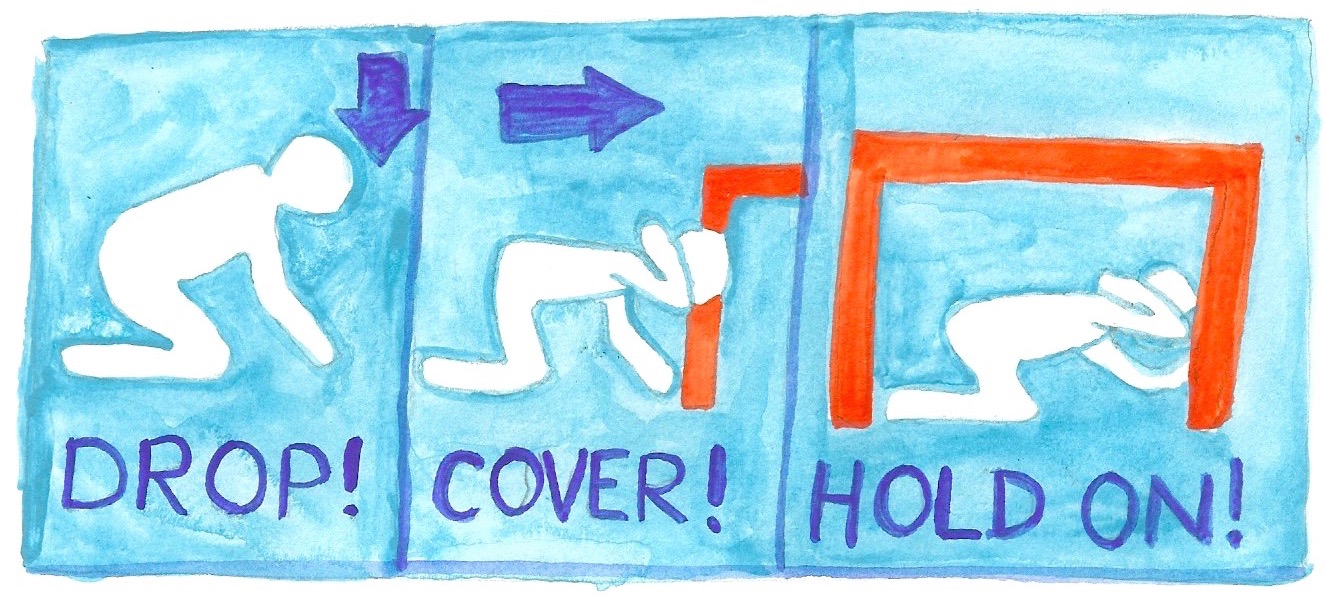
I thought I was. I knew to get under the dining room table and hold on. But I didn’t count on glass on the floor. I knew to have supplies, but I’d have to collect them. I knew to brace the bookshelves … but not the items on them.

And this was not the Big One. That one – 1964 earthquake variety – will be 1,000 times stronger. Moving to a safe place will be hard because we’ll be on hands and knees, doors will be stuck, stairs will collapse. Power will be out for a long time.

Facebook was full of photos of downed shelves, broken glass, demolished pantries. But everyone was Safe. Safe. One-word messages: Safe. Calls from all over the country to hear “Safe.” Things down and broken, but Safe. No fatalities: Safe. So-and-so reported in: Safe.


And in our house, the heavier seder plate fell off the mantel and crushed Sophie’s Noah’s Ark menorah and decapitated the little animals, leaving Walrus in pieces. On the eve of Hanukkah.
Before


After
The next day, while Tim was bracing shelves from multiple directions to handle future shakes, I glued Walrus back together. And then I just put my head down and cried.

Did I cry because all the clean-up was stressful? Did I cry because with all the aftershocks, I hadn’t gotten any sleep? Did I cry for Walrus? Did I cry for Sophie’s childhood? For Hanukkahs past? Hanukkahs future?

No, I cried because Safe is an illusion.

Safe is always an illusion, but when Not Safe arrives with a roar and throws everything all over the place, it’s hard to ignore. When all the evidence around you – and all your friends and neighbors – are dealing with Not Safe, it’s an epidemic of Not Safe.

For a while, Anchorage was ecstatic about how it could have been worse: an amazing story of an intersection collapsed and no one hurt. But then the reports came in: two schools are Not Safe and won’t be reopened. Houses came off foundations and are Not Safe. Gas lines broke, roofs caved in.

We all have to walk around every day believing that we won’t be murdered or knifed or kidnapped, but it’s hard to believe your house won’t fall on you when some houses did. It’s hard when the earth keeps shaking. And shaking. And then you remember: life is precarious. Life is always precarious.

Pretty quickly, yes, humor appeared: my friend Connie lost a whole china cabinet and called the pile of glass “Chihuly-esque.” I looked at the bookshelves and saw new opportunities for de-cluttering and donating: why keep books to potentially fall on our heads? Kitty made a mosaic of her broken vases. And we sought each other out: spending a day cleaning up the library, gathering to tell stories, finding out who needed help.

Noah’s animals made it through another Hanukkah. They propped each other up, held candles tipping in every direction, and did what they could despite cracks, missing pieces, and rubble all around. They’re hurting, but they didn’t sink. Just like us.

Thursday, October 5, 2017

Ready for the Big One?

In the wake of all the Nature-made disasters that have befallen the world lately – Puerto Rico, Mexico, Florida – the subject of “being ready” has come up. At one dinner, one friend went through all the supplies his neighbors have gathered: one has a year’s supply of food, another has 10,000 rounds of ammunition. His wife said, “I have craft supplies.”

I have craft supplies, too. All the women at the table had craft supplies.

Our neighbor says he’s ready because he has a Prius. My husband said that might buy him two days over the rest of us, but I’m not sure how far he’ll get … or what he’s actually ready for. His back stairs fell down so he doesn’t even have a second exit.

Are you ready?

Well, I was once. When Sophie was a baby, Tim fixed our bookcases to the wall so they couldn’t fall on her (never mind the books), and I stocked the pantry, identified the flashlights, filled water jugs. But after a while, I gave up changing the water, the batteries in the flashlights corroded, and maybe we ate some of the supplies. Then I figured we could just raid the closet with the camping gear – at least we have camping gear.

But now, as I look around me, I realize that with the new-carpet-relocation, bookshelves were moved, and they’re not anchored to the wall anymore. In fact, come the earthquake, if I’m at my computer, I’m squashed. Squashed by craft supplies.

So why am I bothering you (and me) with this issue that gives rise to a massive avoidance response? Avoiding the horrendous “to do” lists of identifying hazards, organizing emergency supplies, even gathering important papers? Just give me some sand to stick my head in.

But Thursday, October 19 is the Great Alaska ShakeOut. At 10:19 a.m., all over the U.S., millions of people will be dropping, covering, and holding on in the world’s largest earthquake drill. I do it every year. It’s a fun way to remind us – wherever we are on that date and that time – however inconvenient it is – that earthquakes are inconvenient, too.


Even if I manage to avoid the pre-drill recommendations (those readiness checklists), I still look around my 10:19 environment: What’s going to come crashing down? What protection is immediately accessible? How do I get away from windows? Call it my exercise in mindfulness….

And then, of course, there’s the theater of it. The website provides sound effects you can put over a P.A. system, but I’m kind of partial to the air horn shock to the system. Then picture everyone scurrying and climbing under tables. At the Literacy Program, there are people who have been in scarier earthquakes than I have – earthquakes in places without building codes – so our preparation will probably include some good stories, too.

So even if you haven’t stored your gallon of water per person per day for three days; met your self-sufficiency requirements for up to two weeks; or even own a crank radio – even if all you have are craft supplies – you can remember what NOT to do:
  • Do NOT get in a doorway (old myth)
  • Do NOT run outside
  • Do NOT believe the so-called “triangle of life” (new myth)
Just Drop, Cover, and Hold On with 100,000 other Alaskans. Sign up today and I’ll meet you under the table.

Saturday, March 12, 2016

Living Vertically

There are lots of things that thrill me about cities, but the one that never fails to amaze me is what I call “people living on top of each other.” Not in the figurative sense of crowds, but in the literal sense of people living in an apartment on top of someone else’s apartment on the floor below. I stand at ground level and look up at what’s going on in lighted windows: someone eating is completely unaware that someone just below him is watching TV. It just amazes me.
In New York City, I can look up at an apartment building and see SIXTY people living on top of SIXTY people who are living next door to another SIXTY people living on top of their SIXTY. It boggles the mind. Which leads to the other thing that awes me: at 8 a.m., all those people are usually changing places. They’re leaving homes for work or school or whatever, and they’re often doing it via public transit. It’s why I got into transit in the first place. Just think about it: all the people living on top of each other changing places in about a two-hour period.

Gasp.

So when I heard that the curator of the Skyscraper Museum exhibit, Ten Tops, was doing a curator’s walk-through, I went. (There are so many exciting things implied in that sentence: that a Skyscraper Museum even exists, that it’s a dynamic museum with changing exhibits, and that they offer a curator’s walk-through and expect people will come! This is New York!)

The exhibit focuses on the two dozen or so buildings that are 100 stories or higher. The Burj Khalifa building in Dubai has the highest occupied floor in the world. More than 900 households live there with the possibility of living on top of 87 floors of other people.

But the big thing I learned from the curator was about wind. The museum is filled with the models used in wind tunnel tests. I learned wind is why these buildings are all pointy or oddly shaped. Wind is a killer on a regular old rectangular building; you need angles to confuse and disrupt the wind.


One of the more inspiring buildings, the Shanghai World Financial Center starts out at the bottom as a square, but the architect used angles and arcs drawn off a circle to slowly transform it as it rose so that at the top, it’s six-sided. The very, very top was designed to have a circular hole (and they’d install a ferris wheel), but when the owners saw it, it looked like the rising sun of the Japanese flag so it was nixed. Now it’s a rectangular hole.


To understand how scary the wind is, the curator showed us photos of the “tuned mass damper” (TMD) in Taipei 101, which was the tallest building till Burj Khalifa. It has to withstand not only typhoons – up to 130 miles per hour – but also earthquakes. The structure likes to be flexible, but the people inside like it not to be so flexible. (I can see why.) So inside, there’s a giant 660-ton sphere, 18 feet in diameter – that’s the TMD – that hangs like a pendulum around the 90th floor. When the wind blows, it swings the opposite way and stabilizes the building. It can swing up to 59 inches!

[Pause while woman from Alaska-via-San-Francisco has small, sympathetic freak-out over this: swaying from wind and earthquakes is the worst thing I can imagine in the place where anyone would live. 59 inches – that’s almost five feet of sway! And that’s the stabilizer!]

I am staying in an apartment on the 8th floor. It is not so bad because the people on the ground still look like people, not ants. I can look out in the morning to see whether they’re wearing coats or not (although New Yorkers seem to wear parkas and scarves that would leave any Alaskan with heat stroke). I am not anticipating any earthquakes.

So while I’ve always marveled at looking at all the people living on top of each other, this is the first time I’ve actually been one of those people. Sitting here at my table, I’m not even aware of the seven households under me. I only see them from outside. I haven’t even checked how many might be living above me; I’ll have to look at the elevator buttons.
It’s a new perspective: to be what you’ve always just looked at. But that’s what this whole trip was meant to be about.


Sunday, January 24, 2016

Shaking and quaking back home

The wonderful thing about travel is all the excitement that gets added to your life, and the wonderful thing about our Third Thirds is that we get to travel more.

So why was our wonderfully exciting trip to New Orleans so totally upstaged by an Alaska special as we landed back home? A special 7.1 shaker of an earthquake to be exact.

We were coming in from Seattle about 1:30 in the morning. I was wrecked, jet-lagged, tired, and the turbulence was rough. I was thinking how living in Alaska means you’re always flying home wrecked, jet-lagged, and tired. I hate turbulence. It’s just such a relief when we land on firm ground and taxi in.

Except then the plane went cockeyed. Bumping and wagging, flopping and bucking. It felt like it was jumping and kicking. I thought the pilot had a heart attack or something. And then he announced it was an earthquake. The airport had lost power so we couldn’t get the jetway hooked up and the door opened. So we sat.

When finally power came back, it was dark in the jetway so the pilot asked people to use their phones to light the way. I pulled out my trusty headlamp (so pleased it had a use other than not keeping Tim up when I read in bed).


At home, the parrot was on the floor. The wooden parrot. He sits atop the bookshelf and is our too-late warning system; when he falls, we’re in the middle of an earthquake. And all the kitchen drawers were open. But since I’m such an earthquake preparedness fanatic, all our shelves, water heater, etc etc are braced so we’re good. (Remember the Great Alaska ShakeOut?) But I’m sure we’ll be finding cracks and little relocations over the next day or so.

This trip to New Orleans was not a relocation reconnaissance trip; it was just a fun vacation. And I’ll tell you all about the fun, the music, the curiosities, the eye-openers. But it’s interesting what feelings the trip and the earthquake have left me with.

We spent time in the Louisiana State Museum’s terrific “Living with Hurricanes” exhibit in the Presbytère, and it convinced me I didn’t want to live with hurricanes. There were all sorts of facts like how Louisiana is losing a football field of protective wetlands every 90 minutes, and how people are realizing now that the flood control structures they put in place decades ago are the source of the problems today. While we were there, the river was 17 feet above normal, and it all seemed so unsustainable. And our river guide told us about having to strip his entire house in order to rebuild the drywall and there was just so much muck and devastation after Katrina.

And then, of course, the East Coast was just getting pounded by blizzards and they were folding up streets and transportation and battening down the hatches for the siege. I thought of our last trip to Colorado: Sophie’s iPhone interrupted our drive with a warning to take cover from a tornado expected in 8 minutes. All I could think was, I don’t want to die in a tornado.

I didn’t even need to hear our New Orleans river guide tell us that during the summer he has to change his shirt seven times in a day because of the humidity or how our B&B hostess rests after a shower so she doesn’t work up a sweat toweling off.
So there I was, reflecting on hurricanes, tornadoes, and blizzards for which people are unprepared (like lions and tigers and bears) … and then I land in the middle of an earthquake. And I’ll tell you I was … relieved! I was glad to get home to the place where snow isn’t an enemy, where we know just what to do with what Nature throws at us because this is what our Nature throws at us.

Is this just a really odd way to say “home sweet home” after a trip?


Thursday, October 8, 2015

Drop, Cover, Hold On! Next Thursday

One thing that does NOT bother me about living in Alaska are earthquakes. They bothered me a lot when I lived in San Francisco, and the whole Cascadia thing in Oregon has got me more freaked, but they don’t bother me here.

In San Francisco, I knew friends who checked the time when they got in BART crossing the Bay so they’d know when they reached the halfway point and then which direction to walk in the event of an earthquake. When Sophie moved to San Francisco, I gave her earthquake supply lists, directions about turning off the gas, all that. In San Francisco, earthquake awareness is ever-present, and people are prepared.

I go to all sorts of talks on earthquakes, and I’ve seen the maps that show Alaska completely blackened by the dots that show earthquakes; but here in Alaska, most of my days don’t pose earthquake danger. Maybe a tree will fall on me on the Coastal Trail or the earth open up near Earthquake Park, but I don’t hang out in tall buildings. I guess the Tudor overpass could fall down. Hmmm…

This, of course, is part of the problem: being blasé about earthquakes. I mean, most people were more prepared for Y2K. So last year, I got into my newest earthquake discovery: the Great Alaska ShakeOut, one of the largest earthquake drills ever. October 15 at 10:15 a.m., thousands of people all over the country – all over the world – will be Dropping, Covering, and Holding On. Me, too.
Last year, I got a whole building to do it. I especially loved getting the board members in a Board of Directors meeting to go under tables. It’s incredibly funny to be adults looking at the world from under a table. (It’s incredibly funny to be adults under a table.) At ShakeOut.gov, they even provide audio messages with sound effects to announce the beginning of the earthquake. The big thing is looking around from under the table and noticing what things might fall on you and need bracing or relocating.
ShakeOut.gov is full of good information. I just learned that we’re NOT supposed to stand in doorways, that the doorway bit was a myth stemming from photographs of California adobe homes with only a door frame standing. So now I have to find a new safe place.

This year, I’m getting the students, preschoolers, and fellow volunteers at the Alaska Literacy Program to go down under tables. Many of the students there come from other earthquake-prone countries where everyone runs out of their houses. You all know you’re not supposed to do that, right?

Look around you: who can you get under a table? Someone in a suit and tie? Someone in a mini-skirt? Someone with tight pants? High heels? Too funny. Really, this is one of the big reasons I do the ShakeOut. My clothes, despite all my best intentions, are still earthquake-ready. Not only can I get under a table; I can probably crawl out of a crevasse.

Join me and 76,000 other Alaskans. Sign up today.

Sharing Button