Pages

Showing posts with label retirement. Show all posts

Thursday, August 1, 2019

Invasion of "the Other"

My husband has retired.

[Pause for those of you who’ve already experienced this and are either cringing or just waiting to hear what I write next.]

It’s an adjustment. First came panic, then came hostility, now there’s … contentment.

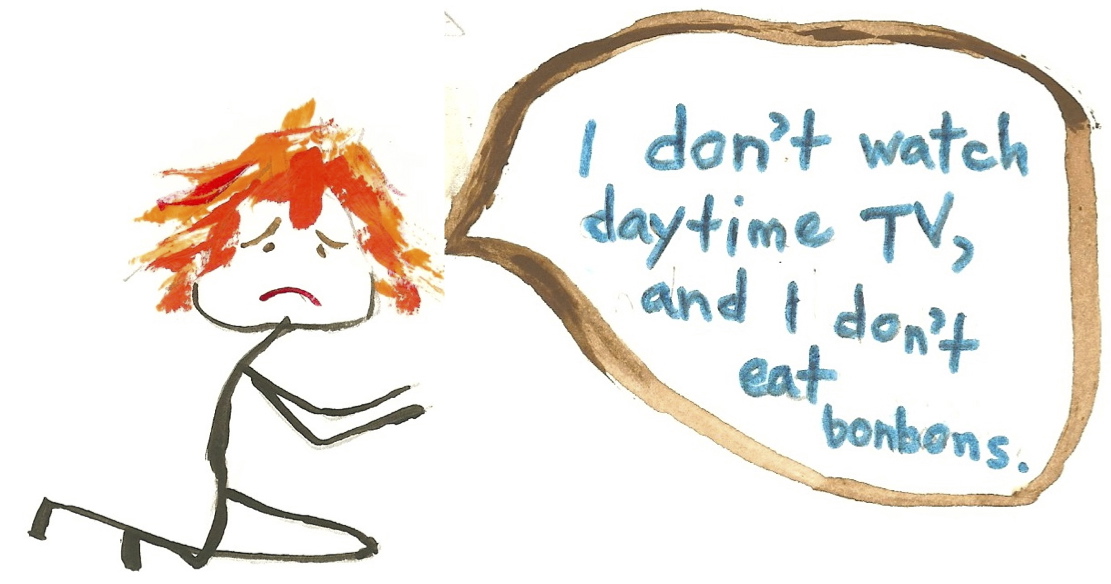
The panic had to do with my space. I have my own office/studio, but pretty much, the Whole House has been mine for the last few years. He left in the morning and came back in the evening. I wasn’t observed.

For the first days after he retired, he didn’t just observe, he hovered. That must have been when the hostility surfaced. He thought I was going to be available, and I had my own agenda, I owned my own days. [Look at all these words in bold! These are strong feelings.]

According to quantum theory, observation of something changes that something; and I know that’s actually happening: his observation of me is acting on me, changing me. I can get really existentialist about all this and quote my own philosophy thesis on Sartre’s horror of objectification by “the Other.” My “Other” is looking at me.

Whoa, I just now realized how my two main areas of intellectual interest actually overlap!


Anyhow, we got that straightened out. He mostly leaves the house in the morning, and I can share the house by going somewhere else in it. Thank heavens for rooms, multiple rooms. (Although he has observed that while he keeps all his personal items in his office, my personal items manage to migrate to every single common space in the house.)

When my mother first visited us and met Tim, she was enthralled. She and I were sitting at the dining room table, and Tim was wandering around the house, looking up and around. He was looking for light bulbs that might need changing. My mother oohed, “Oh, he’s handy! He’s looking for projects!”

Right now, as I write this, Tim is trekking the lawn, looking for dandelions that need pulling. Tim relaxes by doing things.

I relax by doing nothing.

I know what you’re thinking: she’s not doing nothing, she’s writing. Well, I only interrupted my doing nothing because I needed to tell you about doing nothing. I’ll go back to doing nothing.

I’ve always had issues with productivity and categorizing myself as lazy. Mostly, I try to consider a day productive if I’ve done two things. It used to be three things, but in the summer, I reduce my requirement to two. I count lying on our deck as the extra because I’m outside and not on the couch.

Yesterday, I picked up a paint chip to see if the color would work for our front door. That counted as one productive effort, so I lost momentum because I was also doing laundry; my productivity quotient was met. I thought today I might wash the door, but since I’m writing this, my door-momentum has faded. Besides, I also returned a book to the library when I was picking up the paint chip.

I am married to a man who will get the paint chip, wash the door, paint the door, clean up afterwards, and count all that as one productive effort. And he would have finished it by now – in one day! – except that I claimed the door as MY (eventual) productive effort. But with one mumbled comment, it’s clear he has observed my inactivity, thus proving Sartre’s – and my – horror of “the Other.” I am seen doing nothing! It doesn’t help that I am also forced to observe his activity.

Fortunately, “the Other” has other benefits, such as companionship. Today’s second productive effort will be going on an outing with him. I adapt.


Sunday, July 30, 2017

OLÉ! Hooray!

I took a job!

Why this should not be such shocking news:
  • I have always said I was unemployed, not retired
  • It’s not a job as in “regular job” which would confine me in the box of hours and location and desk. It’s a “gig,” but a long-term one.
But it’s not a gig, either. I’ve had contracts. Contracts are work you do and then move on. On a contract, you don’t say you’re with an organization. You don’t identify with it; you’re not paid – or authorized – to think beyond the job you’ve been asked to do. And finish. And move on.

I’ve written about my usual (previous Thirds) happy process of finding something that captures my interest and then a job emerges and then I fill it. But how in my Third Third, job-like things didn’t spark that interest and didn’t emerge. Art and travel and community efforts did. Jobs felt confining and limiting and would interfere with all the other interesting things I wanted to do. I gave up looking. I couldn’t face the box.
But I am not a good unemployed person, either:
  • Pretty sure I have some personal difficulty with an overdeveloped work ethic
  • Certain my sense of work ethic is still stuck on the equation of personal value with getting paid
  • Still suffer from identity crises which equate that work ethic with my role in the world
Obviously, just occupying my Third Third has not solved those thorny psychological issues: I am not a poster child for Just Have Fun. But every now and then I re-learn an important lesson: Patience, Things Work Out.

Which is why I am happily now in the perfect job for me!

I am the new staffperson for OLÉ, Opportunities for Lifelong Education in Anchorage. An all-volunteer group that has already grown to 383 members and will celebrate ten years on October 2, OLÉ provides courses, field trips, and engagement for the over-50 set. I have both taken and taught courses over the years and thoroughly appreciate the people who have made all this happen.

I’ll get to use my skills – part-time – in outreach and building partnerships, in supporting volunteers and ensuring sustainable operations, and in adding diversity to an organization. I like what they do, and they like what I can offer. Most of the hours in my days and days in my calendar are still my own. I can still do art and blog, still teach at the Literacy Program, still play.

But I also get to say, “I’m with OLÉ. Let me tell you more about it.”

It’s a perfect match!

Wednesday, January 11, 2017

Not Looking

When I began this blog over a year ago, I said I didn’t consider myself retired; I considered myself unemployed. My usual habit was to work hard, unemploy myself, take a break, explore some things, and find the next exciting job to occupy me. This was only my latest break.

In my mind, I wasn’t “retired” because I don’t have a pension. And I expected I’d get a job because that’s what I usually did. I liked having a regular place to go, helping something grow, being part of a long-term mission. I liked the identity that came with being part of an organization.

But the things that captured my imagination weren’t coming in the form of jobs. No, what was really interesting me was art, travel, community efforts. New Things.

But then – as readers of this blog know – after a while I just felt adrift and untethered. No structure imposed by work hours, no purpose other than what I could impose on myself. I was doing contracts – and I like them a lot – but they aren’t regular and don’t come attached to a workplace, co-workers, and an occupational identity. My existential crises ran amok. I was lonely. A job seemed a solution.
So now, here we are at today. A job prospect came my way that’s actually intriguing. I think it would involve working with interesting people, would involve some travel, would even include writing. Of course, it would ease financial pressure.

But if I took that job, what would happen to my month in London (the newest iteration of my month in Manhattan)? What about the prospects for an artist-in-residency at Hagley in Wilmington? What about all the things that I do between 9 and 5 each day? How will all my volunteering fit in? What about all the things that don’t get done even with all the time I have now?

How can I possibly squeeze myself back into the box that a regular job requires? 

See where I am? I think this is called a crossroads. Or just Identity Crisis #402. I really am on a different road, a road that for the time being does not involve a job. But because I can over-think anything to death, I have a whole bunch of questions for myself:
  • I have LOTS of years left in my Third Third. Have I opted for the pleasure route too early? When I decide I want something different, will employment opportunities have passed?

  • If not-employed is now my decided route – not just a de-facto-it-happened route – what does that mean? Do I get more serious about what I’m doing? What does that mean, to “get more serious”?

  • How many of my decisions are just laziness decisions, evidence of some responsibility fatigue?

  • How much of this is just incredibly selfish in not taking financial pressure off my husband (even though he denies feeling the pressure)?
In the end, none of these questions matter. I can’t do it. I just can’t take a regular job right now, can’t put myself in that box. I couldn’t sign on a dotted line, set an alarm clock every morning, sit at a desk in an office. It feels absolutely impossible. Every fiber of my being rebels. Why?

Because I like my days.

(Eye-opening wow.)

It took me a while to get to this point, but it’s true. I’m in my Third Third, I’m in charge of my days, and I like them!

Monday, November 7, 2016

Who cooks dinner?

So let’s say you enter your Third Third earlier than your spouse: who does the cooking?

Do you:
  1. Do more of the cooking because he/she is still working (and earning income) and wouldn’t it be nice for them to come home to a hot meal? (with pleasure)
  2. Continue to share the cooking/household chores because you worked hard to establish an egalitarian household and you’re committed to that in your relationship? (with pleasure)
  3. Do more of the cooking because … (same as #1, but with resentment)
  4. Continue to share the cooking/household chores because … (same as #2, but with resentment)
I know there are some people who are delighted with their newfound time to cook and prepare meals. Those are the women who lined up at the Friends of the Library book sale in front of the cookbook shelves. Those are the folks who take photos of the meals they’ve prepared and post them on Facebook. (Yes, I do know ONE MAN who does this.)

I’m not those people. Mostly, I kind of forget about eating until I have a headache, BUT when I cook, I like it to be healthful, non-meat, and not processed. That takes time. This is the weekly cycle we’re on:

Monday: I cook delicious healthy meal with side dishes. I have to stop what I’m doing at 3:30 for this to be possible, but I am pleased with my effort, and my efforts are appreciated.
Tuesday: I cook delicious healthy meal with side dishes. I have to stop what I’m doing at 3:30 for this to be possible, but I am pleased with my effort, and my efforts are appreciated.
Wednesday: I have to make extra trips to the store for a missing ingredient that is not in stock at two stores (corn meal!?). This particular meal turns out to have a few more steps in it than I’d anticipated so my day gets eaten up with meal preparation. I decide husband is not properly appreciative. I have to stay up late to get my personal stuff done that I couldn’t get done during the day.
Thursday: I assemble a meal of delicious leftovers. I watch husband like a hawk, evaluating whether he is eating his way through the leftovers so we won’t get another meal out of them. I fill out angry survey form for grocery store that did not have corn meal in stock.
Friday: Husband is picking up on clues. He starts saying things like, “I’m making a list with some items I want to cook for a meal. Do you have anything to add?” I feel bad because he has contributed 40+ work hours to our household this week and now I am frightening him back into egalitarianism because he knows me and knows I am ready to blow. I feel very grumpy about all this, but I did not quit my job to cook dinners.

My husband and I had achieved a very nice balance during our working years. He did things; I did things. We both parented. Every now and then, I’d get miffed because my things were do-over-and-over-again things and his were big-project-achieved kind of things, but we worked out a balance of effort. I’ve never mowed the lawn; he’s never tended the garden. If something broken required glue, he fixed it; if it required sewing, I fixed it. We rotated regular meal preparation, but mostly he cooked food, and I cooked meals. Things felt even.

But now, I have more flexible, “leisure” time. And in talking to many women friends, that creates a guilty burden of “we should be” cooking dinner. And the problem with guilty burdens is that eventually resentment finds its way in. I’m sure my husband would say I shouldn’t feel this way, that I’ve earned my time, that I contribute to the household (if not at the same income level as before), but that’s because he’s nicer than I. He’d also say peanut butter is fine for dinner.

So other than giving myself a personality transplant (attempted, never successful), I’ve been trying to come up with solutions to the perceived Dinner Burden:
  1. Maybe peanut butter, yogurt, or whatever scrounging yields can be counted as a meal. Maybe dinner-as-meal is a Second Third thing. Maybe Third Third dinner needs to be re-imagined as bits-of-this-and-that, not a whole meal, but still sitting down together. Maybe a dinner meal can then be a surprise kind of thing, as in “Oh! You made dinner! What a nice surprise!”

  2. Browse my magazines and collected recipes and get enthused about cooking one of those creations?

  3. See a lot more movies at the Bear Tooth and eat dinner there?

  4. More giant soups, more salmon, sandwiches? Great volumes of leftovers? Start a recipe folder of “easy”?
Taking suggestions….

Wednesday, July 20, 2016

Is leisure something we have to earn?

If after leading his country’s fight against apartheid, after spending 27 years in prison, after serving five years as his country’s president, if after all that, Nelson Mandela had just wanted to retire and relax; would he worry that he was lazy and unproductive? Would his legacy remain intact?

Tuesday, I wrote about the wonderful, accomplished, generous Sharon. But now I’m going to add a little more to the story. When Sharon saw the post I’d written about Shirley Mae, this is what she said, “She is such a force! I am now feeling completely inadequate to even being interviewed by you. I do nothing in retirement but sew, have dinner parties, a little gardening, and make gifts for people.”

Do you recognize yourself in a headset like this? I do. Almost every woman I know does.

There are two directions my mind goes when I think about this. There’s the general legacy question – and why I added the Nelson Mandela example: when can someone rest on his or her laurels? In retirement, do the accomplishments of our previous Thirds give us a pass to just enjoy our Third Third? If we work hard, do we get to play? (Listen to me! I know I sound like some rigid Puritan debating whether we’ve earned enough points for heaven, but it’s a real question.)
And then there’s the self-esteem question, which is particular: do I feel like I’ve personally done enough, contributed enough? If things count, do my things count? Did I earn my play time? And if my things don’t really count, that means any leisure on my part is just an excuse for deep and unrelenting laziness.

Yes, even I know this sounds very hair-shirt-ish – I’m starting to think these last two paragraphs are grounds for seeking therapy – but that’s the extreme version. I think the question goes to our sense of “ought” and “should” and worthiness.

It reminds me of the annual Women of Achievement Awards, an annual YWCA event. Hundreds of women would listen to the stories of the awardees: they saved lives, started businesses, raised kids who got Ph.D.s, baked their own bread, won elections, and – oh, by the way – built their own houses. These are incredible women and we applauded them … and then walked away feeling mediocre (at best).

We are supposed to be inspired by these stories, and we are. But … then we catalog our deficiencies.
My friend Connie and I were noting how we are so generous when we look at other people and their value in the world and so un-generous with ourselves.

As my friend Linnea was preparing to travel overseas – as she was hustling to get it all together – she took the time to write me a note. I’d been in one of my “I am a value-less time waster” phases, and she wrote a note to tell me how I’ve made a difference in her life. My reaction? Delight and pleasure and … why wasn’t I as thoughtful as Linnea in showing appreciation?

We have to stop doing this!
    (Uh, oh – has everyone else already stopped and I really do need therapy???)

A long time ago, a friend was into enneagrams, which (near as I can tell) are like some new age Myers-Briggs personality categories. I was a 4. She said I could see how something would be really terrific … if just this change was made. Fours look at a room and say, “It’s decorated beautifully; it just needs a lamp over there.” Supposedly, we notice what’s missing.
We can’t all be 4s when it comes to ourselves!

When I was pregnant, I thought about what life lesson I would want to impart to my daughter. I summed it up as “touch the world with care and when you leave, leave love behind.” I haven’t been a good poster child, but I still get shivers when I think the thought, and I see it clear as day when I reflect on Sharon and others who demonstrate kindness in their lives.

So maybe today’s thought is to extend that same kindness to ourselves.


Monday, July 18, 2016

Profiles in Third Thirds: Sharon

Let me tell you about Sharon. Sharon is my hero (and role model). For all the time I’ve known her, she has put her energy into improving the world. She just reminded me that we first met when she was teaching workshops on training nonprofit boards and I was in one of her classes. But after that, Sharon went on to start the YWCA in Anchorage. She took it from a tiny, little one-person operation to a major force that owns its own building, positively impacts thousands of women’s lives, and is thoroughly sustainable even when Sharon left after many years.

During all this, she served on the School Board for 7½ years and, not to go unmentioned, was a BizBee judge for TEN YEARS. (We both love spelling and grammar.)

So now Sharon is 75 and retired. Her Third Third? Pursuing her domestic hobbies: mostly wool appliqué and cooking. She has a sewing room dense with projects and hundreds of cookbooks (a thing which totally mystifies me – I can’t even imagine how one would begin to peruse that many cookbooks. Sharon says looking through a cookbook at the end of a day is her reward for getting some of her to-do list done.) Sharon even batches all her out-of-house appointments and errands so she can stay home most days with her projects.

As Sharon puts it, “I gave up trying to save the world and being personally responsible for ‘empowering women and girls and eliminating racism’ and am content to play a very small part.” But she still registers new voters at citizenship ceremonies and donates her sewing work for nonprofit auctions. Friends receive her gifts, and I love her rhubarb chutney on salmon.
During her professional life, I tried to learn how Sharon balanced it all. Now, in our Third Thirds, I’m trying to learn about contentment from her. She says it took her seven years to “come down” after retiring and give herself permission to enjoy it. She tells me wise things like:
“What is the rush? Have you taken some days to just do nothing since being employed? Taking a day with no goal in mind usually ends up being a day where you end up doing something that you like to do….”
“I’m learning to accept that there are only so many hours in a day and what doesn’t get done today, bar some catastrophe, will get done tomorrow.”
“We realize that we gave it a shot but we can’t save the world so it’s now OK to focus on what makes us happy….”
This is what I’m trying to learn from Sharon even though I still hear a nervous calendar clock ticking away in me: I still don’t know what my next Big Thing will be. What passion will drive me? Do I even know what makes me happy? And besides, is that too selfish to pursue? What makes for contentment?

But Sharon knows – and now has the time for – her passion. Her passion is sewing. She calls it her dessert. In the fall, she’s teaching her first class on wool appliqué at a local quilt shop, but she’s always experimenting with new techniques and tools. She couldn’t show me any of her work – she gives it all away – but we went through photos together.
Sharon made this purse out of ties for her husband’s daughter. She said, “It’s made from his old ties (since he doesn’t wear ties anymore). She loved it and I cried when she told me that she could smell his closet on them when she opened the present.”
Her sewing connects Sharon to the women who came before: “My grandmother had her own little sewing shop and my mother at one time did sewing to bring in extra money.” She’s made pincushions that fit in vintage teacups, folk art designs, and wall hangings. She’s made table runners, placemats, and many, many pillows. She’s even made a crown for a princess. They’re all given away as gifts.
Yes, Sharon finds that her time often just dribbles away with projects getting deferred by the “shoulds,” by errands and appointments and watering the garden. And now, her time is getting squeezed because two big tasks have been added to her to-do lists: cleaning up her sewing room jumble of projects and purging her cookbook collection. It’s the de-cluttering albatross. As she puts it, “I don’t want to leave a mess.”

Sharon tackled the big jobs in her Second Third and is now devoting her Third Third to more personal pleasures. Is it so different? Sharon thinks she’s run out of steam, but she’s still giving of herself. Maybe before she used her talents to empower, to fight racism, to save the world. Now she’s using them to add affection and kindness to those around her. The world is still a better place for having her in it.

Thursday, February 11, 2016

The restructured life cycle -- with bonus years!

Recently, I was lucky enough to get involved in a conversation with an attorney who’d just quit her job, and we found common ground in our tendency to un-employ ourselves. She was calling her time off “practice retirement,” which really appealed to me since I think I still need more practice. But here’s the kicker: this woman is 37 years old. When I was 37 and un-employed myself, it would never occur to me to call it anything remotely like “retirement,” practice or not.

It reminded me of what Laura Carstensen, director of the Stanford Center on Longevity, says. We’ve added 30 years to our life spans, but all we’ve done is tack them on at the end. She says we should restructure our life cycles, put those extra years where we need them. Maybe simplify life during child rearing, maybe add more education later on, maybe extend careers into later life.
So maybe 37 is a good year for this woman’s first retirement. She’s fit, healthy, unattached, and unencumbered.

She’d had a plan for taking a year off, but she’d since come up with more good ideas, and they’d take longer than a year. Maybe a couple years. She was trying to decide on her money situation.

Because, as we all know, you either have money or you have time. I think next week I’ll talk about money, but today I’ll talk about time.

When Sophie was little, I kept thinking we didn’t try so hard to have a child to spend three hours a day with her. I needed time. So I un-employed myself or rather, took a “practice retirement.” After a while, I took a part-time, non-management position for that period in my life. Laura Carstensen is very big on part-time, too.

This wasn’t my first step off the employment treadmill; it wasn’t just a child rearing issue for me. I’d done it before for travel, for restlessness, for enrichment (on separate occasions). I guess I was taking “practice retirements.”

This reminds me of the two different kinds of hikers: the ones who aim for the destination and get there and the ones who stop for lunch, stop for snacks, stop for rests. The former want to relax at the end; the latter want to keep it pleasurable along the way. At different times, I’ve been both and been annoyed by both, but now, reflecting on the whole span of human lives, I’m thinking maybe taking it in bits is the way to go. If it’s an analogy for our lives, what is the “there” to get to anyway?
I’ve been calling this my Third Third, which supposes that I’ll live till 90 (just supposing). That means I have a whole third before me! That is 30 years – just about the increase in life spans over the century. That’s a lot of time. As Carstensen said, if people just aim for retirement – if that’s their “there,” their destination – that makes for an awful lot of retirement years to fill. (I read somewhere that after ten months of “retirement,” many retirees grow dissatisfied, maybe bored.)

In fact, if we took Carstensen’s ideas to heart, we wouldn’t have a Third Third at all. We’d have Sixths maybe, or Eighths, as we spread ourselves over the full course of our 90 years. She thinks we should aim our peak employment years for our 50s, relax during our child-raising years. Maybe in our Fourth Eighth, we’d go to college again. Maybe in our Fifth Eighth we’d head back into the employment world to the max.

These are the questions I ask: From your perspective now, how would you “restructure your life cycle”? What would you have moved around, delayed, done earlier? How do patience, wisdom, financial resources, and energy levels fit into the mix? And now, how does that apply to your Third Third? Would you add a second college-going interlude, another way of being with children, another bout of heavy-duty employment? What seems like it would have or still will work best for you?

What if those 31 additional years weren’t “extra” but were “integral,” incorporated into the whole? What would our lives look like … and how differently would society have to be organized?
So many questions. If this is what swims around in my head, I guess I can subject you to some of them, too. Let me know your ideas. That’s what the “Comment” form is for. (And for those of us who were wondering where that is, it’s after my last sentence, after the time I posted this. Found it? See, we are not tech dinosaurs!)

Monday, December 28, 2015

All the world's a stage...


I think the first formalized stages I’d ever heard described were Elisabeth Kübler-Ross’ five stages of grief after the death of a loved one or similar bad news.


Recently, I heard of the six stages of retirement described by gerontologist Robert Atchley:

And now, I’ve discovered the Nine Emotional Stages of Holiday Travel:

1   Nostalgia 4   Frustration 7   Annoyance
2   Anxiety 5   Calm 8   Excitement
3   Productivity 6   Happiness 9   Relief

So I guess if we were just looking at the complexity of the process, it takes more steps to do holiday travel than it does to retire, and it takes more steps to retire than to get over a loved one’s dying. Okay, I’m being facetious.

Kübler-Ross’ stages don’t begin with looking forward to something – hers are all about reacting to horrible news – so she’s missing those steps of positive anticipation. But it seems to me that the other two processes are basically the same thing: looking forward to something, making plans, confronting the reality of that which you wished for, feeling bummed, and then recovering. (The travel one has more steps because it’s a round-trip: you get to visit family – with both positive and negative anticipation … and then you get to come home.)

This is called a PGIO. I learned this in college:


After hearing this, I bet you’ll see PGIOs everywhere, too. These same five steps apply to everything:
For instance, a First Third, college example: (1) I really wanted to go to that party, (2) I called up friends to go with me, (3) place was full of drunk assholes. (4) What a waste of an evening! (5) So let’s all talk about it and hoot and laugh over at the coffee house.

Now a Third Third example:
  1. My job ends in April; I can hardly wait for all that free time

  2. I’m going to take an art class, finish binding those books, finish the quilt, travel

  3. I seem to be drifting, not getting any of it done, and I’m not a very good artist anyway

  4. Yikes, what have I done! Am I going to be this worthless and unemployed for the next 30 years?!

  5. Oh, I get it: I’m making my own future. Who knew it would involve blogging, some contracts, teaching, ice skating? But I need to impose some structure for this to work.
The thing is, I have a hard time seeing these steps as describing a period of my Third Third (or any third). It makes it sound like once you move through the steps, your caterpillar has turned into the butterfly. Well, even the grief folks say that’s not true; you can keep repeating the cycle as new realizations or situations hit.

I think there are two versions of this cycle: the daily one and the Big Picture one. I had the daily one just yesterday, with the quest for the calendars: (1) Today I’ll buy my new calendars, (2) Off I go to the store, (3) They’re all out, (4) It’s taking forever to find the calendars I want; 2016 is a mess already, and (5) Wow! I found a way to get the calendars after all.

But the Big Picture one: can we only see it in hindsight? Do we only see the stages of our lives as we move out of them?

[to be continued due to the existential crisis of the author who found herself in a paroxysm of re-evaluation, self-examination, and relentless rumination]

Thursday, December 17, 2015

Profiles in Third Thirds: Allan

When the last son started college, Allan retired, hopped on a bike, and turned his fantasy into reality. That was 14 months ago. Since then, he’s biked 9,817 miles through the United States and Europe, returning home every three months or so for visits. After the winter, he’ll be back at it (when there’s more light and less cold rain). But for now, he had a chance to reflect on the whole experience, what it’s meant, what it does for him.

Allan’s living the life of a nomad. He bikes 40 miles per day on average and spends 98% of his time alone, carrying 80 pounds of gear (with tools, clothing, extra food). He isn’t a “go where the wind blows” kind of traveler; he does tons of planning. He knows where he’s going to make decisions – to go here or go there – and when he expects to stop each day. He has no particular destinations, looking instead for what he calls the “in between” experiences: going through back alleyways, trying to pick the best strudel each morning in Germany, guessing which sausage will taste best.
Why?

Yes, it’s being outdoors. Yes, there’s the realization of how very many nice people there are in the world (a real plus after years in code enforcement). Yes, there are moments of pure exultation, of flowing well with the universe, of immense gratitude for all the people who’ve helped along the way. Allan says sometimes he emerges from dreamland, miles down the road, having been pleasantly “off” somewhere. No, he doesn’t really aim for museums; he suffers “museum fatigue” after having worked at one for many years and secondly, that requires stopping for two days so he can make sure his bike is secure. And yes, he does make wrong turns, ends up in terrible mud, has to push his bike.

After many months doing this, Allan notices how it becomes his life. His life home, in Alaska, becomes “that other life.” His wife and son are keeping the home fires burning, with the oldest son now able to handle home maintenance and enabling Allan’s fantasy to come true. As Allan puts it, he was and remains a dutiful son, a dutiful husband, and a dutiful father. Now he has no responsibilities “up until the next phone call.”

Does anyone want to join him on this adventure? No, Allan said, his wife turned down the invitation and his sons are busy with their lives. Besides, right now, it’s a solo, self-supported trip; his one vote makes all decisions unanimous. If he vetoes one of his decisions, there’s no over-ride. And, Allan says, you’re on your own for so long that the whole experience “induces thoughtfulness.”

I can imagine a Third Third life that’s a break from responsibility, from the expectations of other people, from the likelihood that tomorrow will match today. Most of the Third Thirds I know are extensions of desires – more travels, more volunteering, more creativity – but they remain within the confines of their “regular” life. Allan’s is a fantasy realized. To do it, he had to leave his regular life. He – and his family – had to take a big leap and adapt. I think of my fantasy – a year in London, a year in New York City – and I wonder what (other than money) is stopping me. Did Allan just really, really want his more?

Allan had taken a previous long bike journey when he was younger. Now, he says, he’s not 25. He has “weary leg days” – days off for when he just loses his oomph. He tries not to go past 80% of his personal limit. If he does 100%, the next day he’s only at 60%. Recovery takes longer at age 60. Besides, Allan says, “There is always another day,” he can get there tomorrow, and “being tired all the time isn’t fun.”

He’s a stickler for safety, doesn’t ride in the dark. The first time he had to ride on a divided superhighway was scary, but now he realizes riding on the shoulder with cars 12 feet away from him is actually safer than having them right up next to him on a narrow country road. But what about when things go bad, those days of mud or freezing rain or worse? “You always get through it,” Allan says. “There’s nothing I couldn’t do again.” Allan was a professional firefighter: riding a bike in civilization isn’t the hardest thing he’s had to do in his life. As he puts it, it’s not even wilderness.


So where’s he gone actually? He started in Chicago, reached the Mississippi River and headed south. He crossed along the southern border of the U.S. to California and up to San Francisco. After family visits, he again took off from St. Louis, this time east to the Atlantic Ocean via the Erie Canal Trail and Massachusetts. After a summer bicycling in Alaska, Allan flew to Europe, where he’s bicycled along the Rhine and Danube Rivers, stopping in Serbia for this winter’s return to the U.S. Total miles since retirement: 9,817.
Allan’s story doesn’t just push the Third Third envelope; it bashes the concept of an envelope, period. So now I’m sitting here thinking: What if? How far? How big the dream?


Sunday, November 8, 2015

Solo in the Third Third

I’ve got Tim.

I’m married to him, and that changes my Third Third dramatically. I have two sisters, both single, and at least one of them has a whole different reaction to the notion of retirement because she’s single. Even the prospect of travel planning changes when you don’t have a ready-made travel partner. Even remodeling options change when you don’t have a spouse who’s measuring, cutting, painting, and nailing in all the molding on the new floor.

I would not be sitting here figuring out my future if I didn’t have a husband. I’d be at my job.

One sister lives alone in her single-family home. The other lives in a large, woman-occupied building with two roommates. When I think of the issues we’ve been having lately with my mother – her anxiety at being alone – I think of how we may have to re-structure our living situations in our Third Thirds.

As our neighborhood on Long Island became increasingly the domain of widows, I tried to convince my mother to get together with her best friends and all move in together. “I don’t want anyone else in my kitchen,” my mother said. So now they’re all anxious about living alone.
Aging hippie that I am, I’ve lived in housing with lots of folks. Then we bought three flats in one building and all lived there. Anchorage even has a co-housing arrangement that broke ground. I’ve always thought it was nutty for every household to have a washer and dryer, and as we get older, there are even more reasons to share space.

But you have to be willing to share. Maybe even your kitchen.
Back to Tim. He’s younger than I am, which increases the chances that I’ll die first. Lucky me! Seriously, when we look at our Third Thirds, we have to know that whatever’s in place now may not be in place later. The best retirement plans in the world can shatter with the death of a spouse, not to mention divorce.

My friend Judith recently traveled with her sister. Her sister almost jokingly described it as a practice trip for when they were both widows. I take a road trip a year with one sister, and one circle of women friends is looking at the Chilkoot Trail for next summer. But I understand what my one sister is saying: it’s the planning for the Third Third that benefits from a partner, a life partner.

I keep telling Tim we need a “theme” for our Third Third (so much so that’s he’s probably thinking how much easier his Third Third would be if he didn’t have me in my Third Third at the same time). What I mean is a theme we craft together. (With a life partner, that planning involves negotiation – something the singles don’t have to accommodate – but that’s the subject of a different post.)

I’m a pretty independent sort. I do what I want, don’t need Tim to accompany me, and am ready to try New Things. I’ve been toying with the notion of spending a year in New York or London without Tim. But that still means we’d confer on logistics, resolve finances, and communicate with each other. We’d still be partners, and in a crisis, we’d be on the next plane.

When I was younger, I used to say that having a boyfriend meant I didn’t have to fret about New Year’s Eve. In my Third Third, my sister points out that I don’t have to think about who my emergency contact is or who will hold my health care proxy.

And this doesn’t even get to the issues of those who, Oops, forgot to have kids.

Sunday, October 4, 2015

The Time Wars: Productivity vs Blank Spaces

So there we were, a group of retired, unemployed, women on breaks. Guiltily, we broached the subject of how unproductive we’d become. One woman raised her hand and said, “I’m Sue, and I waste time.” One by one, we raised our hands.

In The Third Chapter, Sara Lawrence-Lightfoot’s study of retirement, she writes of one high-powered woman who played online poker endlessly when she retired. Granted, none of us were playing online poker, but we felt just as decadent. Somehow, just as work expands to fill the time available under Parkinson’s Law, not working expands to fill the time available, too.

When I was a super-productive but nuts mother of a young child – working, picking up the kid from child care, getting dinner cooked, spending enriched time with family, child bathed, etc. etc., I stayed up late to write a novel titled “Blank Spaces.” I thought then – and always have – that the best of ourselves emerges in the blank spaces of our lives, the times when we can be contemplative, generous in spirit, and creative. My life had zero blank spaces.
Very soon, I decided I would work reduced work weeks. My whole family could tell the difference between Barbara Monday-through-Wednesday and Barbara-Thursday-through-Sunday. I am a believer in free time!

So why do I spend such a lot of time beating myself up over not utilizing my free time more productively?

My friend Sharon says it took her seven years to “come down” after retiring and give herself permission to enjoy it. (Her husband says it took him seven minutes….) Sharon asked, “Have you taken some days to just do nothing?” Yes, I said, but for a long time I felt terribly anxious about it.
When I unemployed myself, I had three big projects I wanted to complete: a quilt I’d started a couple years ago, mounting all my old Daily News columns in four hand-made volumes, and … I can’t even remember the other one. Or rather, of all the un-done projects facing me, I’m not sure which is the one I put on that list.

I approached my projects with a huge amount of energy and I was a marvel of productivity! And then I wasn’t. They’re 99% done, and then they went on pause while I de-cluttered, fulfilled some contracts, traveled, took a class, taught a class, yarn-bombed. I think now I tend not to “count” what I do accomplish, and even that word makes me nervous because I think I’m an accomplish-aholic.

Enamored with my new spiralizer, I started cooking recipes I’d torn out of magazines. I’ve torn them out for years, but they just accumulated in my big stash. Recently, I started cooking some of them, and they’re terrific! I used to cook to feed hungry mouths. Now I cook to taste flavors.

That’s when I recognize that I’ve found a new rhythm. A Third Third rhythm. It’s so calm, so accepting.

And then I browse through an art book and think, Oh, if I were more productive and used my time better, I’d be able to experiment with this medium or try this technique. And then I write about embroidery and think, “Hmm, why haven’t you done any in a while?”

Way back when, my friend Eric was planning out his ideal day post-graduation: Sleep, eight hours; work + commute, nine hours; exercise, one hour; keeping current on world affairs, one hour. You get the drift. It added up to 27 hours daily. Eric said, “I’ll work it out somehow.” So this is the crux of the problem: we have 27 hours’ worth of intentions and wishes but there are only 24 hours in a day. We’ve never let go of the three hours “lost” from our day. I have LOTS of ideas for those three hours. I have six hours of ideas for those three hours.
One of the things I used to do in workplaces that had become unhealthy is make people go home. I told them they’d lost awareness of what was sustainable, what was do-able in a normal workday. They were killing themselves with overtime and unreasonable expectations, and morale was suffering. See, I told you I was a believer in free time.

So now I have to figure out how to add free time to my free time.

Monday, September 21, 2015

Profiles in Third Thirds: Sherry

Sherry and I have been friends since high school. Last summer, she and her husband quit, retired, sold their house, and moved to their cabin in the Yosemite area. When Sherry read my blog, she sent me a note with phrases like this:
“I learned that I love and need a schedule of activities to help me organize my days.”
“I learned that I need to be around other women and I need to exercise!”
“I also need to be around children and help in a classroom!”
Uh, oh, I can read between the lines: all that learning meant Sherry had figured out life wasn’t so good without those things. Sure enough, she said they’d never really planned any of this to happen, but when the ball started rolling, it went unexpectedly fast, and she found herself without “a job, a schedule of daily events, or close friends to hang out with…. After retiring and moving, there was an abrupt halt after a life of movement. I did visit … friends and we also did some traveling, but when we were home all day, I was lonely. I didn't know exactly what I needed or wanted.”

Sherry had been a much in-demand tutor and had a very full schedule. Now she was asking, “What should I be doing? What is my purpose?”

Oh, she and her husband had spent the last year “getting our lives in order: our cabin, our finances, our cars, our travel, our health insurance, our digital & paper files, our photos, our old clothes, our furniture, our recreation, ad nauseum!”

So cleaning out the detritus of our lives doesn’t count as purpose…. But this is a very happy story because Sherry discovered Silver Sneakers!
Silver Sneakers is a gym class “with a boisterously funny and warmly welcoming group of women our age. Talking to the women in the silver sneakers class taught me a lot about the area, like shopping, hiking, swimming at the high school, local events, and that, in turn made my life richer.”

She’s now working with a personal trainer and filed an application to volunteer in a kindergarten class. “We bought kayaks and go out to explore our lake in the early morning before the boats are allowed to tow skiers, between 7 and 8 am. At the top of one of the tallest trees is a huge eagle’s nest and sometimes we get to see the mother and baby eagles up there.”

What a happy Third Third story! Is there a Silver Sneakers in your life?

Thursday, September 17, 2015

When Structure Goes

When I quit my job, I torpedoed structure. Left to my own devices, I’d get involved with something and stay up all night. I’d have commitments, contracts, or meetings, and I’d do them just fine; but the rest of the time, I was a free agent. Nothing was “fixed” and there was no regular schedule. I did something because I felt like it, not because it was routine. In the beginning, this was joyful, glorious freedom.

When my book club read Daily Rituals: How Artists Work; everyone shared the daily rituals of their lives, and I cringed. There was nothing routine about my days. But instead of feeling liberated and free, I was beginning to feel erratic and unstable. My sleep hygiene was a mess, and I tended to drift aimlessly between being and not being in the mood to do this or that. Sometimes I ran in the morning, sometimes in the evening. I always ate breakfast, but sometimes that was at 9 a.m. and sometimes at 2 p.m. While other people might think it was the sign of a free spirit, I knew it was courting craziness.
I told my book club, “I believe the absence of routine in ordering my day is really thinly-veiled absence of self-discipline. So I did something I ‘didn’t feel like’ yesterday … and it was just fine. Then I stayed up till 1 a.m. to give me back the part of the day I’d relinquished.”

I enrolled in an art class that met twice a week and had demanding homework. That helped in many ways – and I’ll write about that more – but doing art with deadlines for projects means you’re still pushing the sleep hygiene envelope. Or maybe that’s just me; everything pushes my sleep hygiene envelope. I’d charge ahead highly motivated, get stuff done, and then walk around spacey and sleepy getting nothing done.

While I was flailing around uselessly, I came across a newspaper article which quoted Ernie Zelinsky, author of The Joy of Not Working. In the article, he said, “There are three big needs jobs provide that people have to put back into their lives in retirement….” I’ll call them the Big Three, and I’ll write about them a lot more:
That’s it! I knew structure was an issue for me. Even back at college, I learned to sign up for the breakfast plan so I “had to” get up at 8 a.m. And when I was finishing my thesis and worked part-time, I worked 8-10 a.m. and then 1-4 p.m. It was my way of imposing structure on my days.

But now, with no external source of structure (job, driving kid to school, etc.), I was rootless. I’d sit in the living room free to read a book on an afternoon, but I couldn’t relax. Somehow, without a Time to Go to Work or a Time to Go to Class, I felt like I didn’t have a Time to Relax either. I don’t think it was feeling that relaxation was undeserved, just that it didn’t have a beginning or end. My friend Sherry called it feeling “untethered.”
Yup, that’s the word.

Wednesday, August 26, 2015

Is this unemployment?

Groups of friends meet every week – during the day because they’re not working – and they call themselves “retired.” I’m not working, but I call myself unemployed. And even that’s not accurate because I have contract “gigs,” but mostly it means I don’t go to the same place on a regular basis, get a regular paycheck from there, and have a boss. But if you’re a certain age, people assume you’re retired.

But I think I’ll eventually get A Job so by my definition, that means I’m unemployed.

I don’t do unemployment so well. Which is odd because I unemploy myself regularly. About every five years or so, after pouring myself into the venture of the moment, I start feeling restless. I’ve taken whatever I’ve done to new heights (yeah, I think so), but when it turns into “oh, it’s April, in April we do this” and “time to gear up for October,” I start fading.

In San Francisco, running the street and subway operation of the Muni was a 24/7 job before we even had the expression 24/7. When that wore thin, I had this big dream of working internationally and was hired to run the Melbourne transit system. So I quit my S.F. job. But the visa process was so long, I was unemployed for longer than I would have liked. Ultimately, I abandoned Plan A and came to Alaska to People Mover.

In San Francisco, when you don’t have a job, you feel like you have to say to people
I felt like one day I’d look in the mirror and there’d be no reflection. Even though I took classes and got a certificate in Graphic Design, even though I was heavy into major political matters, I felt valueless.

So I wasn’t going to let a job define me again.

This is how my employment cycle works: I have a great 5-7 years. I try new things, make things happen. There are glory years of accomplishment and satisfaction, meaningful work and workplace camaraderie. Then I fade and quit. Then something else emerges.

Yeah, emerges. I look around, something captures my interest, I explore it. Eventually, I’ll talk to someone, tell them how I can fix something or make something happen for them or their organization, and a job emerges that I fill. This is a very happy process that has taken me from buses to theater companies to newspapers to leadership to early childhood.

But something went awry this time. As I looked around, I’d find a potential interest and … nah. What about this? Nah, same old, same old. Ho-hum. Ugh, no way. My whole self winced at the thought of most jobs in my field. I don’t want to sit at a computer. I want to use my hands! I taught workshops for contractors: maybe I’d like to be a tile guy. I thought I’d like to be a check-out person at the library, talking to people about their books. Maybe I would prune trees and fix all the poorly pruned trees I see around town.
I didn’t want to do what I’m very good at; I wanted to try something I’d never done before.

There are several ways to interpret this:
  1. Oh, you’re so eager to explore and try new things. How exciting!

  2. If you don’t figure out what you want to do soon, you will be part of the “long-term unemployed” and you’re 60 now and you’ve read all those articles about how no one wants to hire old people.

  3. You sound really depressed. Nothing interests you. What’s wrong with your whole life?
You get two guesses.

Tuesday, August 4, 2015

De-cluttering 101: Why is this even part of a Third Third discussion?

  1. You have to toss some of your old life to make room for a new life.

  2. If you’re going to relocate, do you want to pay to move it? Or, as one friend said, If you won’t move it, why have it?

  3. If you’re going to downsize, it won’t fit. We’re assuming that in this Third Third, kids aren’t living with us. Do you really want to hang onto a place that has rooms that aren’t used, that you have to heat and vacuum? Smaller = less room.

  4. Maybe your stuff is more valuable donated than sitting in the attic. My mother's 50 years of mint-condition Broadway Playbills could do more for the theater she donated them to than they did gathering dust. That made my mother feel better, too. Goal: doing good, feeling better.

    I once heard a quilter speak about her fabric stash, how she lived in terror of her kids putting it all out on the lawn – “Fill a bag for 25¢” – without realizing that some pieces were truly valuable. Ditto for coin, stamp, and rock collections….

  5. Okay, think about your Third Third: do you want to spend it browsing through old Playbills, gazing at shelves of books you read a long time ago, marveling over greeting cards from relatives long since dead? Do you want to re-read and re-read … or find the latest bestseller?

  6. Advanced Third Third: maybe you won’t remember any of the people who sent the greeting cards so what are greeting cards from perfect strangers worth? And who are those people in those high school yearbooks?!?

  7. Post Third Third: If you don’t get rid of it, someone else may read it. Aiieee! Your kids going through your diaries? Spouses looking at photos of old (very old, maybe dead) boyfriends?

  8. Fact: Children left to clean out your shit curse the amount of crap you’ve accumulated and left for them. And it is all crap to them. They will throw the fabric stash on the lawn with signs saying “Fill a bag for 25¢.” Or worse yet, it all goes in the dumpster. Even kids who would prefer to reuse and recycle just don’t have the time or patience, and they’re pissed at adding to the landfill (admission by kid like that).

"So much energy is released when you no longer carry all those bricks on your head."

    -- borrowed from somebody, then changed a bit


Sunday, August 2, 2015

Identity Crisis #314

So what's the Third Third anyway? My mother is 90. So at 62, I'm looking at things in thirds. First 30 years, second 30, and now: the Third Third. Looking at my life, I see a timeline of decisions debated and decisions made. They're like the points in my life where a life can branch off and generate a whole new parallel universe. The kind where I married that other person or took that other job or moved to that other country. I have crowded the world with parallel universes, but I like where I am so even the bumps got me here.

My thirds fall into groups, with themes. I call my first third Preparing for Adulthood. My second third, that's Parenting, and that includes both the preparation and the adaptation to no longer needing to be hands-on. (She's launched.) It's also, as my sister added, Professional Life.

So what now? What's the Third Third?

You can see my timeline, but first some history....

Back when I was in college, back when I was agonizing over what major to select, I was consumed with identity issues: "Was I a philosopher?" or "Was I a physicist?" "Was I an artist?" or "Was I a writer?" Life loomed in front of me, and it all hinged on that MAJOR DECISION.

The thing is, I'd thought I'd figured out this future bit. (I was a teenager.) I had decided (excruciatingly) where to go to college, where I would be a student. I had become THIS student in that place. I thought I was finished with deciding who I was, where I was, and how I would become. I had walked through those doors to my future, couldn't it just be lived now?

Yes, they were doors to the future, but also doors that slammed shut on alternative futures. My friend Helen pointed out that this was only Identity Crisis #14 (but who remembers the actual number). They kept cropping up!
In between, there were other decisions, other doors, too. They kept appearing, relentlessly. Some repeated. Some were more dramatic than others, but the philosopher in me won out and all of them were EXAMINED.

All those doors, all those parallel universes, this is my life:

Why is this Third Third such a big deal? 

  1.  It's colored by mortality. It's the Last Third. This one leads to decline. No matter how positive I might be, eventually my times in a half-marathon will get longer.

  2.  This one involves accepting that some options can't be picked any more. I can't be a farmer. Okay, I can, but it would take A LOT to make that happen. (Raising the big question: would I want that enough to make it happen?)

  3.  I'm really, really good at some things now, but I'm also sort of tired of them. Do I follow my expertise or my curiosity?

  4. How far do I go to follow curiosity? How much uprooting do I want to insert in my life? Do I want to move? Do I want to "start over" in something?

  5. What legacy do I leave behind? Do I want to cement that, alter it, or branch out?

  6. I don't have a passion. I'm not so in love with gardening that I deliriously welcome the idea of having the time to garden. I haven't waited my whole life to ... write a cookbook or visit all 50 states. I already crossed the country by visiting 25 waterparks....

  7. I need a theme, an over-arching meaning to this part of my life. I don't want to just add up the days, and I don't want to relax or play or travel without something larger illuminating those days.

  8. I am consumed with de-cluttering, but how much of my shit do I discard? I RECYCLED my journals! More on that, but de-cluttering involves deciding what part of your past you keep.

  9. How do I re-insert creativity into my life? For years now, I haven't been doing creative writing or art, both of which were necessary parts of my life. What gives?

  10. How much money do I need to make? Of course no one knows how much money they'll need, but there's also the bit about salary being life's report card, the measure of our worth. Women do seem to suffer from Bag Lady Fantasies, but this valuation thing still plays out with me.


  11. So how am I doing with this Third Third business?

    Maybe not floundering, exactly.

    When public radio in Alaska used to announce my commentaries, they identified me as "Barbara Brown, whose daily collisions with life leave her with great stories and a grateful heart." So I'm still colliding, I still have great stories, and maybe I can gain some clarity here (and force a little for #9).

Sharing Button